IT Literature Intelligence 终审版本 (VERIFIED) 论文编号:
309| 原始基线:V0_ZCODE_BASELINE| 语义审核:pass| 图表审核:pass
Precedence of the eye region in neural processing of faces
Issa · Journal of Neuroscience · 2012 · Zotero itemID=2609
这篇电生理研究第一次在单细胞/多细胞水平刻画了猕猴 IT 面孔补丁系统最靠后的成员——后外侧面孔补丁(posterior lateral face patch, PL),发现其早期响应几乎完全由"对侧视野上部的一只眼 + 一段曲线边界(如脸轮廓)"驱动:单独一只眼(哪怕放错位置)就能驱动接近全脸的响应,而仅仅去掉眼区则让响应大幅减弱、潜伏期延长。它把"脸细胞到底在检测什么"这个问题从整体模板式的想象拉回到具体、可线性求和的特征层面,是理解腹侧流面孔检测最初一步的关键文献。
研究背景
fMRI 已在猕猴 IT 中定位了多个被面孔图像高度富集的补丁(face patches),其中 PL 是最靠后的一个,紧邻 V4,此前只在 fMRI 水平被识别、从未被神经生理学刻画过。已有记录工作表明面孔选择性从 IT 中部补丁(ML)向前部补丁(AL/AM)逐级"组装"(Freiwald and Tsao, 2010),按此层级逻辑,PL 里的特征应当最简单、最可在前馈式的早期响应中被线性地提取出来。而面孔加工到底用什么策略,当时文献里并存两种看法:心理物理学(Tanaka and Farah 的整体加工传统)暗示面孔识别最终依赖所有部件;计算视觉研究(Viola–Jones 检测器、Ullman 的中间复杂度特征)则表明"眼区"是区分脸与非脸物体时信息量最大的区域。早期单细胞工作(Perrett、Desimone、Kobatake 与 Tanaka)曾报告过对脸部件或整脸响应的细胞,但没有人系统回答过:IT 脸加工链条的最初一环,究竟是被"整脸"激活,还是被某个局部特征激活。PL 恰好是回答这个问题的理想地点——它早、简单、可实验驾驭。
研究思路
作者的策略是"先用 fMRI 找准位置,再用多种独立图像集和分析手段交叉验证一个结论"。第一步:用 fMRI 面孔-非面孔对比图指导微电极,借助实验室自研的微焦点立体 X 光定位系统(submillimeter 精度)把记录位点精确投送到 PL。第二步:用标准图像集(脸/身体/物体/场景)确认 PL 的细胞确实"脸选择",并发现面孔选择性峰值出现在响应的头 40 ms——于是把分析锁定在最早一波(前馈性最强)的活动上。第三步:用类似 Bubbles 的子空间逆向相关(subspace reverse correlation)无偏地映射驱动早期发放的面部区域;再用人工分割部件的组合刺激(全部 2^4、含轮廓变动的 2^5−1 种组合)、遮挡条、尺寸/位置/翻转变换、以及九位置摆放等正交操作逐一检验逆向相关的结论。第四步:提出一个定性响应模型(上部对侧视野孔径内的眼样特征 + 边界曲线,线性求和),并据此做出与"整脸检测器"直觉相反的预测——缺眼的脸应当弱、独眼的脸应当强——然后用新刺激验证。多条证据链在同一问题上汇聚,是此文可信度的来源。
方法
两只恒河猴(Monkey 1 雌性 6 kg,Monkey 2 雄性 7 kg),先做 fMRI(MION 造影剂,3T,块设计:五类图像,每类 20 例,800 ms 呈现)定位面孔补丁,随后植入记录室。记录主要用玻璃包被钨丝微电极采多单元活动(MUA),以 300 μm 步进系统采样整个 IT;另有 257 个经离线分选(小波+超顺磁聚类)的单单元(SUA)。刺激为 RSVP(100 ms 开 / 100 ms 关),6° 图像置于功率谱匹配的粉噪声背景上(避免不同长宽比物体间的亮度/对比差异);每 trial 400 ms 中央注视 + 15 张图,眼睛位置实时监控(注视窗口 4°)。分析要点:面孔选择指数 FSI =(F−BOP)/(|F|+|BOP|);响应潜伏期用变化点估计(change point)从 1 ms 分箱的 PSTH 上求出;早期响应窗取各位点潜伏期起的 40 ms(群体分析常用 60–100 ms)。逆向相关映射:高斯窗(FWHM 1.5°,约占脸图 1/16)每 47 ms 随机换位覆盖一张 6° 猴脸,每位点约 1000 帧;对 0.5°×20 ms 的时空 bin 做岭回归求线性权重(split-halves 交叉验证定正则系数),权重图以 shuffle 对照做 z 化;111 个位点的映射质量中位数很高(可解释方差 r=0.52,拟合预测 r=0.46)。部件组合实验手工分割眼/鼻/嘴/轮廓,用高斯窗混入粉噪声填充的轮廓合成图像;遮挡用水平/垂直灰条(6×1.2°)放在五个等距位置。
主要结果
- PL 确实是面孔选择细胞的富集区,且是更早的一站(图 1)。用"脸响应>2 倍非脸响应"的标准,PL 有 83% 的位点达标(ML 75%、AM/AL 88%;n=150/420/82),平均 FSI 0.65(ML 0.56、AM/AL 0.74)。PL 对脸的响应更强且潜伏期更短:脸的中位潜伏期 80 ms,身体/物体/场景分别为 92/92/94 ms;PL 比 ML 和 AM/AL 早约 5 ms(中位 74 vs 79/80 ms,p<0.01)。面孔选择性峰值在响应头 40 ms,此窗口被选为后续分析焦点。
- 早期响应几乎全部由对侧上象限的眼区驱动(图 2、图 3、图 4)。逆向相关显示 111 个位点中 108 个的最优区域中心落在上部对侧象限(即眼所在处),群体 50% 权重轮廓正覆盖眼;少量中间尺寸位点的最优碎片多为对侧眼,较大区域则常涵盖双眼(图 4)。眼区偏好不能归结为局部对比:把局部对比与空间频率均衡(CLAHE)、卡通化(去除纹理边缘)或反转对比后,眼区仍是最强权重(虽整体权重下降)。注视稳定在中央 ±0.5°(90% 置信 0.55°)、无朝眼偏置,排除眼动混淆。眼区权重占比还能预测标准 FSI(r=0.43, n=111),而其他五个非重叠面部区域的权重占比与 FSI 无显著相关。
- 眼选择性的"孔径"模型(图 7)。闪现 3° 小脸做视网膜感受野(RF)映射:PL 的 RF 确实偏上部对侧象限(平均方位 1.04°、仰角 0.99°),但面积约为偏好面孔组件区的 6 倍,两者尺寸仅弱相关(r=0.27)——即 RF 不能完全解释眼偏好。更贴切的描述是:PL 神经元在一个上部对侧视野孔径(平均直径 4.6°)内偏好眼样特征,孔径内最优权重会跟随眼的尺寸(3°/12° 两倍频变化)和位置而移动;脸缩小到 3° 或水平移位后,另一只眼也会驱动响应;倒置的脸使眼移入下半视野后眼区响应消失,而倒置鼻孔位置反而出现响应建议修改为'(作者推测这可能是因为倒置后的鼻孔像是一个落入孔径内的暗圆斑)'。
- 部件线性求和:早期线性、晚期亚线性(图 8)。在轮廓固定的 16 种部件组合中,对侧眼是权重最大的部件,轮廓次之(且轮廓偏好者的 FSI 较低:上四分位眼偏好者均值 FSI 0.97,轮廓偏好者仅 0.59);眼权重与轮廓权重呈负相关(r=−0.75, p<0.01, n=110),提示两者由相对独立的输入携带。改变所有部件有无(31 种组合)发现:早期相位(响应起始后 0–40 ms)的响应可由单部件响应线性求和精确预测(噪声校正相关中位数 0.95,n=32);晚期相位(41–80 ms)拟合明显变差(0.59)且呈亚线性求和——部件之和超过整脸响应。
- 模型预测成立:PL 响应与"是不是脸"脱钩(图 9、图 10)。九位置控制:只有眼放在对侧位置时响应最大(眼作为最大驱动部件的位点占 65%,鼻 25%,嘴 10%)。正常脸去掉对侧眼后响应很弱(尽管知觉上仍是清晰的脸);只把一只眼放进轮廓(甚至"独眼巨人"式的错误摆放位置)就能获得接近整脸的响应;遮挡条盖住对侧眼区强烈削弱早期响应,盖别处几乎无影响。群体响应无法用"脸在场与否"预测,却能很好地用"眼样特征是否处于上部对侧视野"预测——PL 的发放与人意义上的"脸"概念彻底断开。
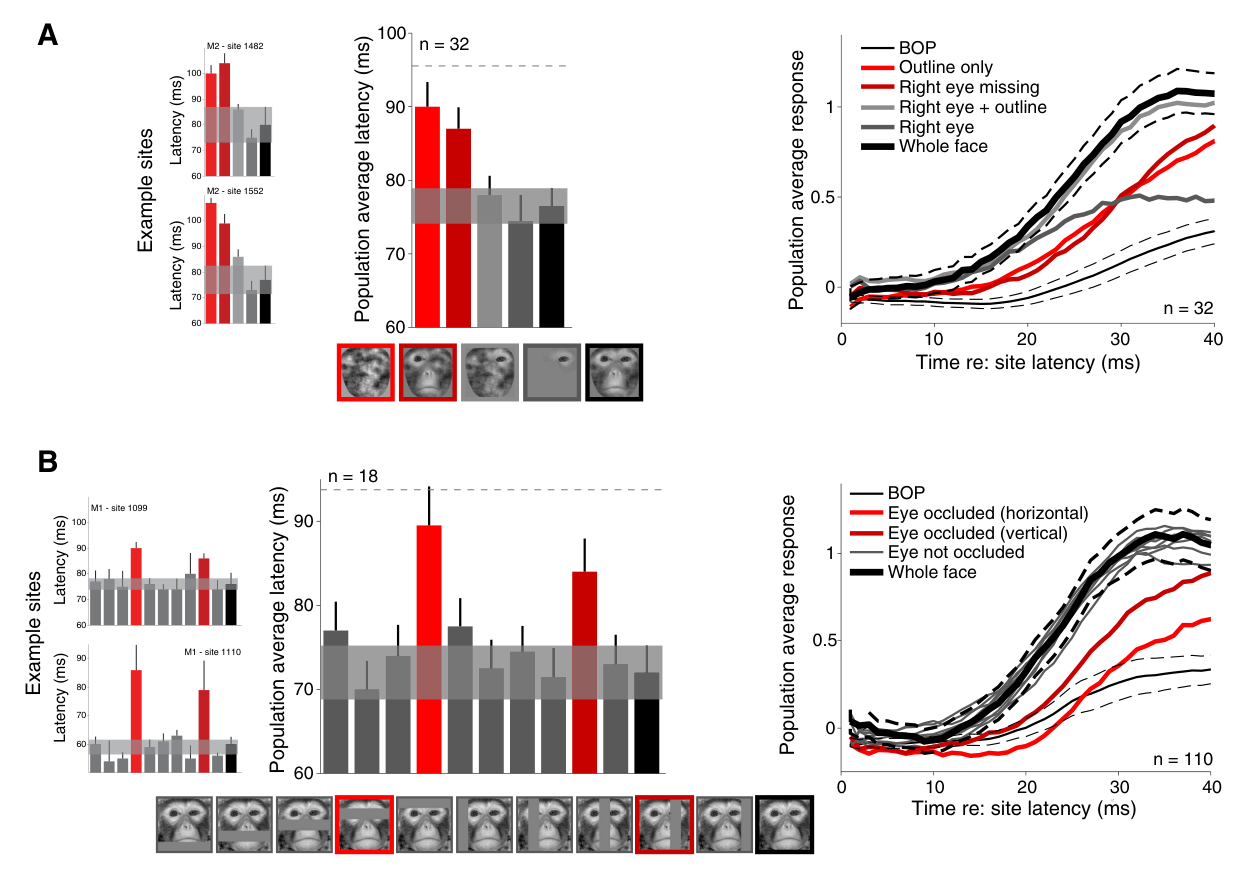
- 单单元与 ML 的验证(图 6、图 11、图 12)。单单元的逆向相关图同样中心于对侧眼(n=38);ML 的逆向相关也偏好对侧眼但一致性略低(109 个位点中 87 个,n=109)。单单元在去掉对侧眼时响应强烈下降(n=51),双眼被遮挡时强降、仅对侧眼被遮挡时弱降(n=12)。潜伏期上:单独呈现右眼与呈现整脸的潜伏期一样短;去掉右眼(其余部件齐全)使响应延迟约 10 ms;水平或垂直遮挡对侧眼区增加潜伏期,遮挡面部其他区域无影响。多单元与单单元在同一图像集上的排序相关高达 0.99(屏集)/0.95(部件组合),群体平均与个体位点的相关 0.78–0.81,说明结论不依赖多单元平均。
图注解读
图 1 · PL 的面孔选择性与更短的潜伏期
原文图注:Figure 1. FaceselectivityinPL.A,Top,PListhemostposteriorpatchintheinferiortemporallobedemonstratingfaceselectivityunderfMRI;MLisalsolabeledforreference.Dataareshownfor Monkey1.fMRIinMonkey2alsorevealedtheposteriorfacepatchbilaterally.Bottom,PhysiologicalmapofmultiunitrecordingsinITrevealsaposteriorclusterofface-selectivesitescorresponding toPLasidentifiedinfMRI(sitescoloredbyneuronalresponsed’forfacesvsthemeanacrossbodies,objects,andplaces;sitepositionsandphysiologicallydefinedboundaryofPL,atitswidestextent in 3D, were projected in native 3D space to the 2D boundary between gray and white matter before flattening of the 2D cortical patch; dashed contour lines are projected Horsely–Clarke AP coordinates).STS,Superiortemporalsulcus;IOS,inferioroccipitalsulcus.B,ResponsesofsitesinPLtothestandardscreensetoffaces,bodies,objects,andplaces(10exemplarspercategory).Top, Individualsiteresponseswereaveragedtogeneratethepopulationresponse,whichisshownrescaledbytheaverageresponsetofaces.Bottom,Siteswerefirstrescaledbytheirmaximumimage response and rank-ordered according to their mean response across face exemplars. C, Comparison of multiunit and single-unit face selectivity distributions (FSI; see Materials and Methods). Antipreferringfacesites(FSI<0)weremorecommoninsingleunitsthaninmultiunits.D,Left,Faceimagesdroveastrongearlyresponsecomparedtobodies,objects,andplaces(grayboxdenotes early response window of 60–100 ms; population-average response shown rescaled by the median response to the whole face at 100 ms). Middle, PL responses to faces had significantly shorter latencies than responses to bodies, objects, and places at all levels of visual drive (measured as d’ of response above baseline; this analysis required between-site comparisons of latencies for responses with matched visual drive). Given that higher firing rates lead to shorter latencies slope, approximately −5 ms per unit of d’), this analysis demonstrates shorter latencies for faces compared to other object categories independent of overall visual drive. Right, The FSI peaked within the first 40 ms of the response.
A:上为 Monkey 1 的 fMRI(PL 是 IT 最靠后的面孔选择补丁,ML 作参照),下为多单元生理记录图——每个位点按"脸 vs 身体/物体/场景平均"的 d' 着色,投影到展平的皮层片上,可见 PL 处形成一个与 fMRI 吻合的脸选择位点簇。B:PL 位点对标准图像集(脸/身体/物体/场景各 10 例)的响应,上为群体平均、下为按脸响应排序的单个位点;脸的响应明显更强。C:多单元与单单元的 FSI 分布几乎一致(单单元里 FSI<0 的"反脸"位点略多)。D:左,脸引发强早期响应(灰框=60–100 ms 早期窗);中,在匹配视觉驱动力(d')的跨位点比较中,脸的潜伏期显著短于其他类别(约 −5 ms/d' 的斜率被控制掉了);右,FSI 在响应头 40 ms 达峰。这张图支撑主要结果第 1 条,也交代了为什么后文聚焦早期响应。
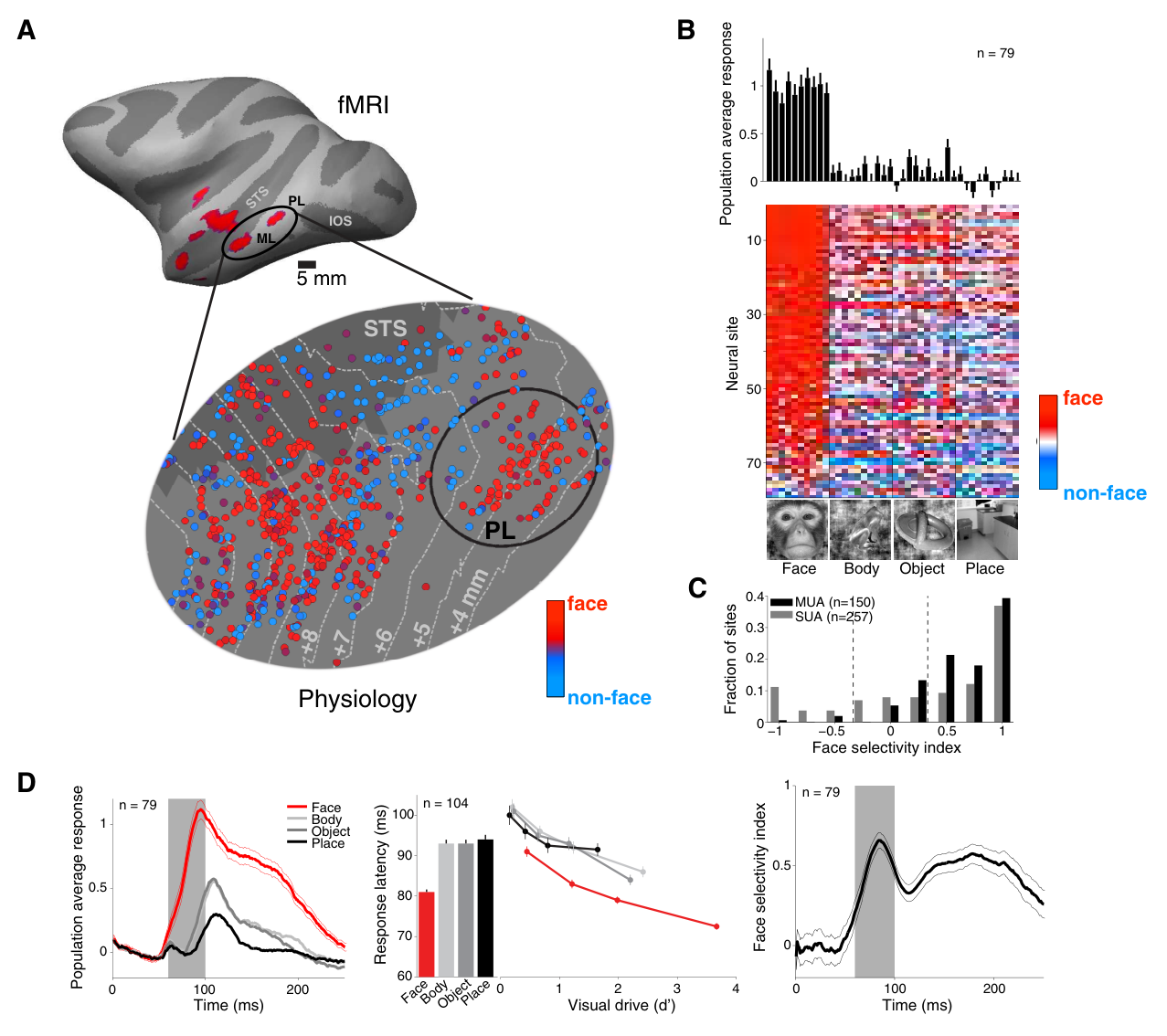
图 2 · 逆向相关映射方法与示例位点
原文图注:Figure2. Facereversecorrelationmapping.A,Gaussianwindowedfacefragmentswerepresentedinrapidsuccession(every47msor21Hz)whilethemonkeyfixatedacentralfixationsquare (white) for up to 3 s. The example site (bottom row) responded strongly during frames when the interior of the eye was present. (Notice the strong response to the first and last frame in the red highlighted region. Frames are offset by the site’s overall latency, 76 ms, to aid visual alignment with responses. The gray region denotes the response level in the screen set to the whole face). B, Top,Reversecorrelationanalysiswasperformedtodeterminethelinearresponseweightingof0.5×0.5°regionsofthefacein20msresponsebins.Z-scoredweightsareplotted.Bottomleft,The spatialkernelsintheearlyresponsewindow(60–100ms;redrectangle)wereaveragedtogeneratetheweightingmapfortheearlyresponse.Bottomright,Theimagefragmentcorresponding to the weighting region at half-height was extracted.
A 是方法示意:高斯窗化的脸碎片以 47 ms 一帧的速度快速呈现,猴子保持中央注视;下方示例位点在"眼内部出现于窗口内"的那些帧上强烈发放(红框区域,已按该位点 76 ms 潜伏期对齐;灰带表示对整脸的响应水平)。B:逆向相关把每个 0.5°×0.5° 区域的线性响应权重按 20 ms 时间 bin 解出(z 分数显示);把 60–100 ms 早期窗(红框)的空间核平均即得早期权重图,其半高轮廓即该位点的"偏好脸碎片"。此图是主要结果第 2 条的方法基础,也直观展示"一只眼内部就能把响应拉到整脸水平"。
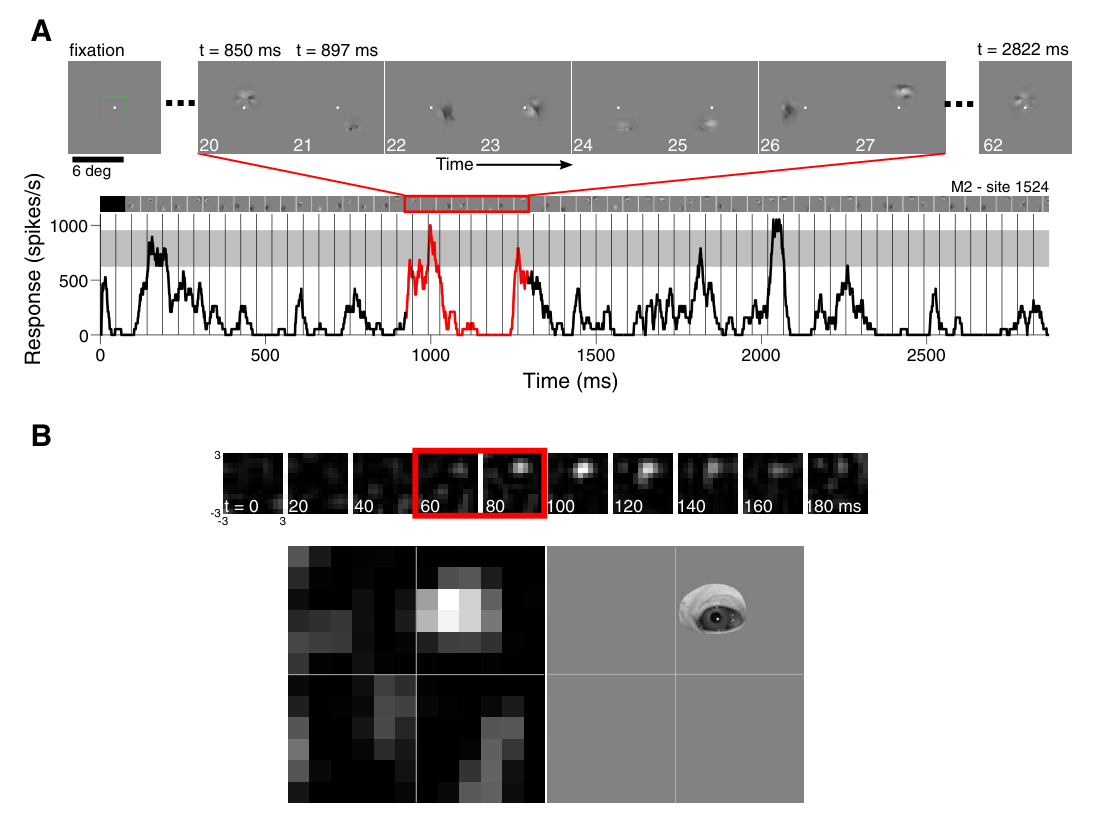
图 3 · 眼区偏好的群体证据与对照
原文图注:Figure3. PreferencefortheeyeregioninPL.A,Inamajority ofsites,weightsintheearlyresponsewindow(60–100ms;redoutline)werecenteredinthetopcontralateralquadrant(left;dots reflectcentroidofpreferredregionforindividualsites;crosshairreflectsmeanandSDofx,ycentersacrosssites;whitedotisthecenterofthepreferredregionfromtheexamplesiteinFig.2).The correspondingfacefragment(50%contourofthepopulationresponsethatwasobtainedbyaveragingz-scoredweightsacrosssites)wascenteredontheeye(middle,right).B,Theeyeregionwas the most strongly weighted part of the face in cartoon (left), CLAHE (middle), and reversed-contrast faces (right). Peak response weights for these manipulated images are plotted relative to the medianofthemaximumweightsfortheoriginalfaceimage(farright).C,Thefaceselectivityindexwascorrelatedwiththefractionofweightsintheeyeregioninreversecorrelationmaps(right) but was not correlated with the fraction of weights in other regions of the face (middle). Six nonoverlapping regions across the face were tested (left).
A:左图每个点是一个位点偏好区域的重心,十字线给出全群体 x/y 中心的均值±SD——绝大多数落在上部对侧象限;中、右是把群体 z 权重平均后的 50% 轮廓,恰好罩在眼上。B:把图像做卡通化、CLAHE 均衡或对比反转后,眼区仍是最强权重部分(右端显示这些操作确实降低了绝对权重幅度,即结论稳健但刺激敏感性有损)。C:眼区权重占比与 FSI 呈中等正相关(r=0.43, n=111),而脸上其他六个互不重叠区域的权重占比与 FSI 无此相关。这张图支撑主要结果第 2 条,并排除了"局部对比/空间频率"的低层次解释。
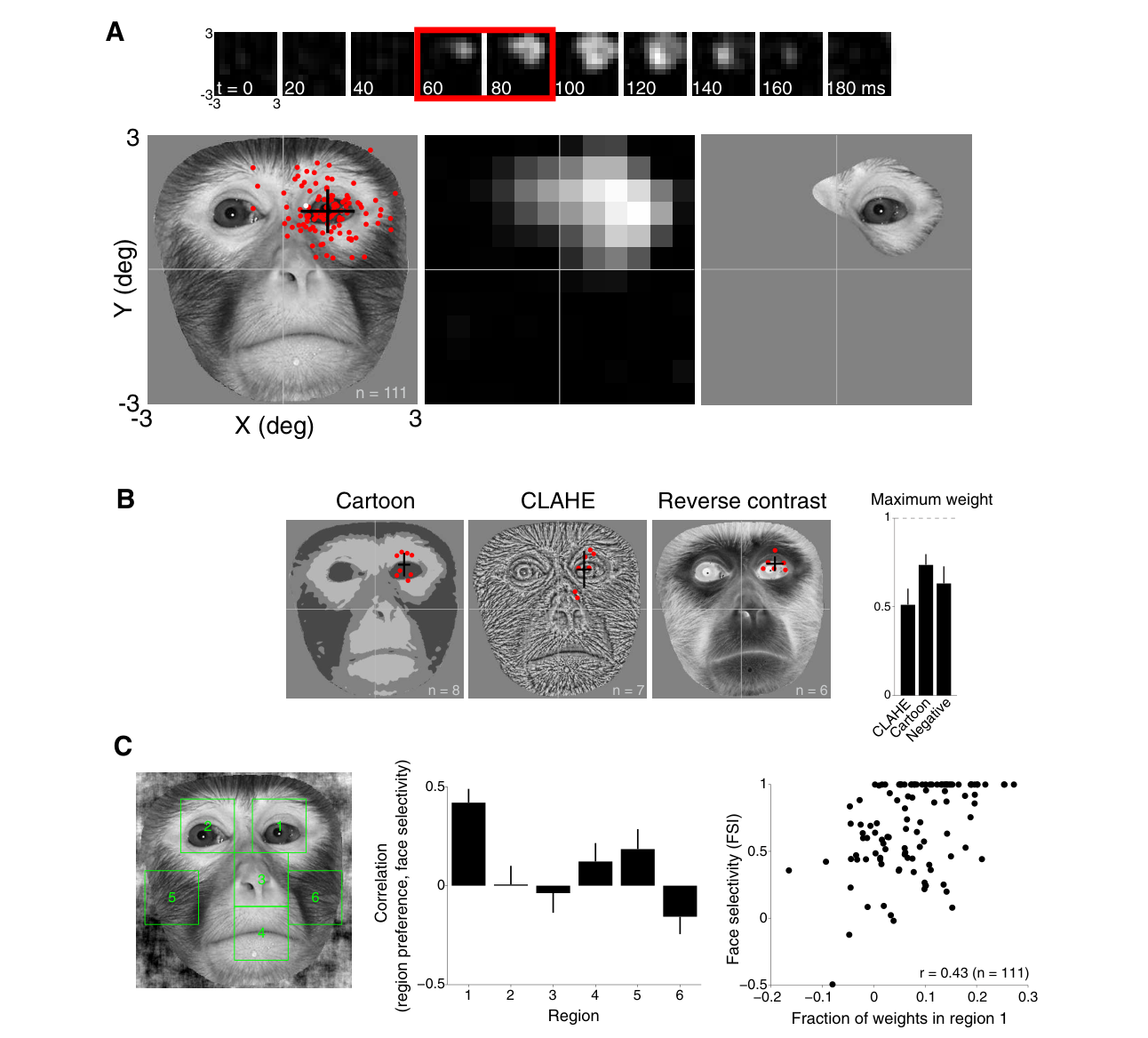
图 4 · 各位点偏好的脸碎片:小区域=眼,大区域=双眼
原文图注:Figure 4. Preferred face fragments of individual sites in PL. Face fragments (50% regions) for individual sites are grouped based on their size and ordered by their relative position for ease of display. A, B, For sites whose preferred regions were small or intermediate in size, the right eye was the most common feature. C, Larger regions tended to encompass both eyes. For sites with multiple half-height regions, only the two largest are plotted, and most sites had only one half-height region (A, B). White outlines mark the edge of the face outline for reference, and features without a white outline lie toward the interior of the face.
把每个位点的 50% 权重区域按尺寸分三组(0.1–2.0、2.1–4.8、5.2–22.0 平方度)陈列:小与中等尺寸的位点最常偏好右眼(对侧眼),大尺寸位点的偏好区域则常横跨双眼;白色轮廓是脸的边缘参考,无白框的特征位于脸内部。此图是主要结果第 2 条的位点级补充:眼偏好不是群体平均出来的假象,而是大多数位点的个体特征。
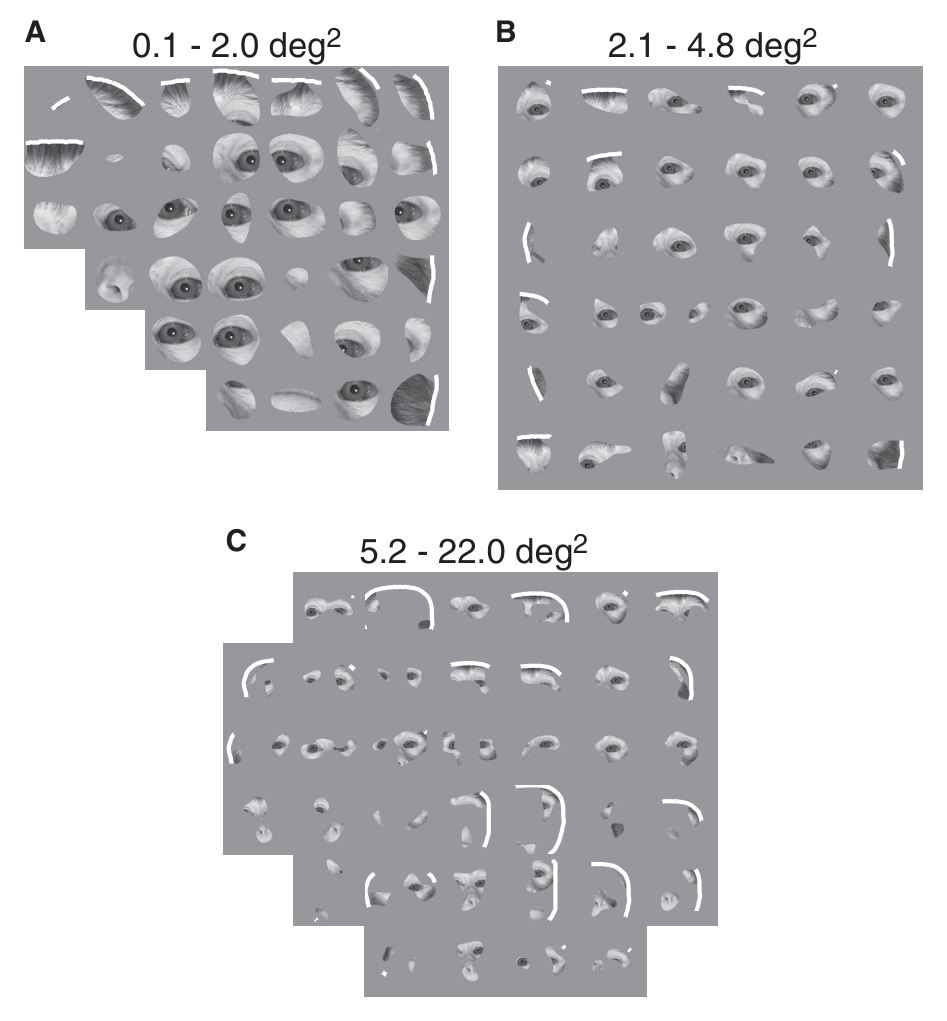
图 5 · 注视控制与记录位点分布
原文图注:Figure 5. Eye fixations and recording locations for reverse correlation mapping. A, Fixation positions during testing with the general screen set and during reverse correlation mapping. Contours represent 90th percentile of fixation positions along each radialdirection(sampledat15°intervals).Polargridsareplottedat0.5°spacing.B,Recordingmapsineachmonkeyareshownfor the subset of sites characterized using reverse correlation. Sites are labeled based on whether they were tested (yellow) or not tested(white).Sitepositionswereprojectedtotheboundarybetweengrayandwhitematterbeforeflatteningofthecorticalpatch (black circle, approximate projection to the surface of physiologically defined boundary of PL at its widest extent in 3D; dashed contour lines are projected Horsely–Clarke AP coordinates; STS, superior temporal sulcus; similar plotting conven- tions as in Fig. 1A).
A:逆向相关测试与标准图像集测试期间的注视位置分布,轮廓为各径向 90 分位——分别只有 0.55° 与 0.46°,且无明显径向偏置,说明猴子并未"偷看"眼区。B:两只猴做过逆向相关的位点(黄)与未做(白)在展平皮层片上的分布,覆盖整个 PL(黑圈为生理学定义的 PL 边界投影)。这张图排除两类混淆:眼动偏差与位点采样偏差(111/150 的 PL 位点都做了逆向相关,两只猴、全补丁覆盖)。
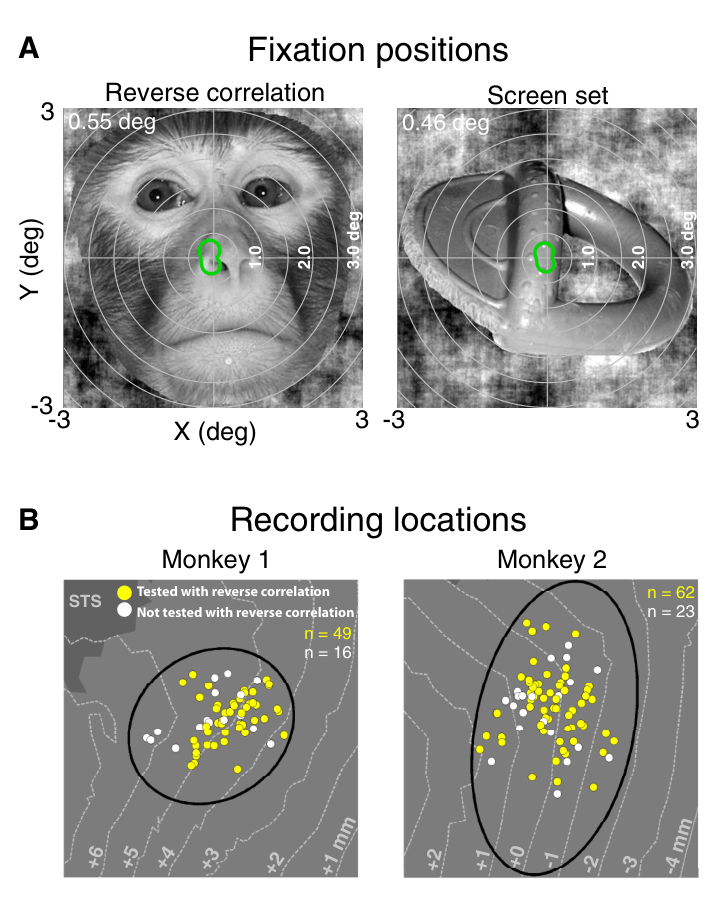
图 6 · 单单元与 ML 的逆向相关复验
原文图注:Figure6. ReversecorrelationmappingforsingleunitsandinML.A,PreferredfaceregionsofsingleunitsrecordedinPLwerecenterednearthecontralateraleye(blackcrosshair;comparetoFig. 3A; same plotting conventions used). B, Preferred face regions of individual multiunit sites recorded in ML (compare to Fig. 3A; same plotting conventions used).
A:PL 中 38 个单单元的偏好区域同样中心于对侧眼(黑十字为群体均值±SD),与多单元结论一致。B:中部面孔补丁 ML 的 109 个多单元位点也普遍偏好对侧眼(87/109 中心在上部对侧象限),但一致性弱于 PL——与"ML 接收 PL 前馈输入、眼信息延续"的观点吻合,也与 Ohayon 等(2012)"ML 细胞主要对眼区对比极性敏感"的结论相互印证。此图支撑主要结果第 6 条。
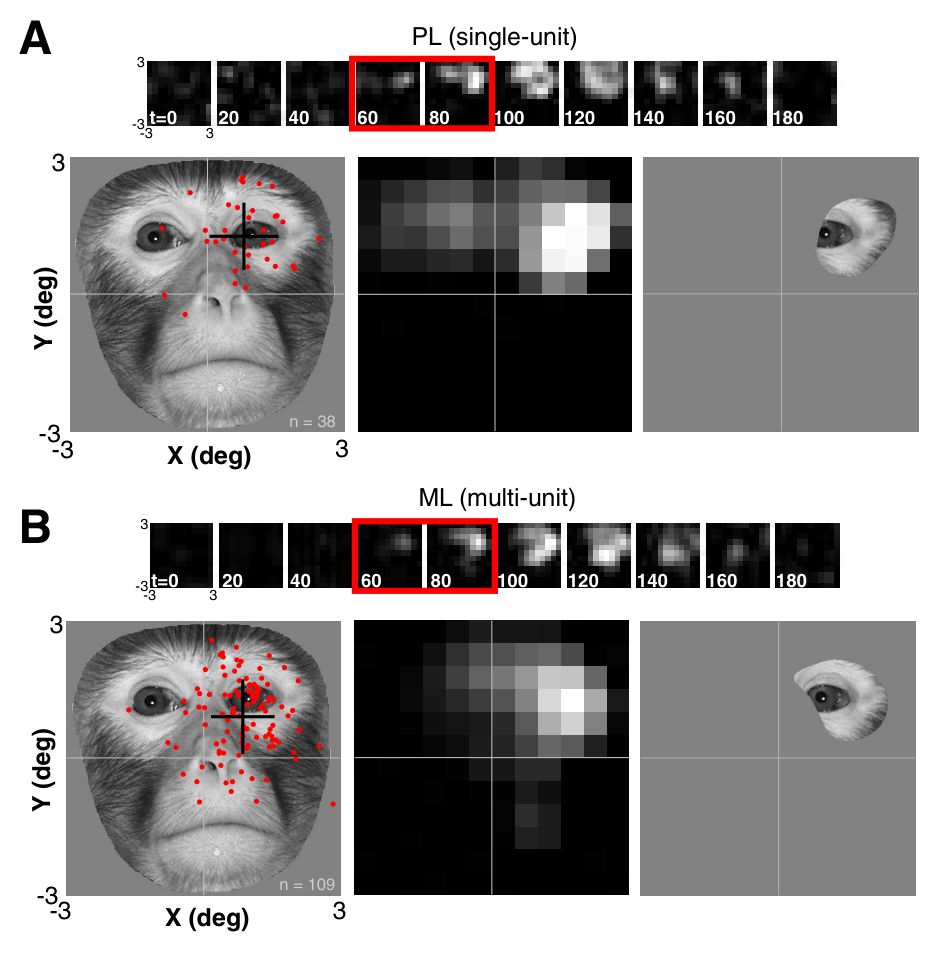
图 7 · 眼选择性的尺寸/位置容忍与"孔径"模型
原文图注:Figure 7. SizeandpositiontoleranceofeyeselectivityinPL.A,Left,RetinalRFsinPL(blackdotsreflectreceptivefieldcentersofindividualsites;crosshairreflectsmeanandSDofcentersacross thepopulation).Middle,ThesizeofRFswasonlyweaklypredictiveofthesizeofthepreferredfacecomponentsofindividualsites,andretinalRFstendedtobelargerthanpreferredfacecomponents. Right, The population retinal RF (yellow outline) was larger in size than the population-averaged face-component region (red). B, The eye region was preferred (Figure legend continues.)
(图注截断;据正文与 B–E 部分图注续文:眼区偏好在尺寸跨越两个倍频的变化后仍保持;水平移位使左眼进入对侧视野后左眼取代右眼成为主要驱动;倒置的脸中眼移入下半视野后权重中心并未完全跟随下移,倒置鼻孔附近出现响应;各操作下最大权重幅度与原图像相当——即偏好区域随眼的尺寸/位置移动,但响应强度稳定。)
A:左为 PL 视网膜 RF(散点+群体十字,平均方位 1.04°、仰角 0.99°),中为 RF 尺寸与偏好组件尺寸仅弱相关(r=0.27, n=60),右为群体 RF(黄)明显大于群体偏好组件区(红)——说明眼偏好不能归结为 RF。B–D:缩放(3°/6°/12°)、水平移位、倒置条件下,最优权重跟随眼的位置/尺寸移动。E:各条件的 50% 区域合成图,提出定性模型——PL 在一个上部对侧视野孔径(平均直径约 4.6°)内偏好眼样特征。此图支撑主要结果第 3 条。
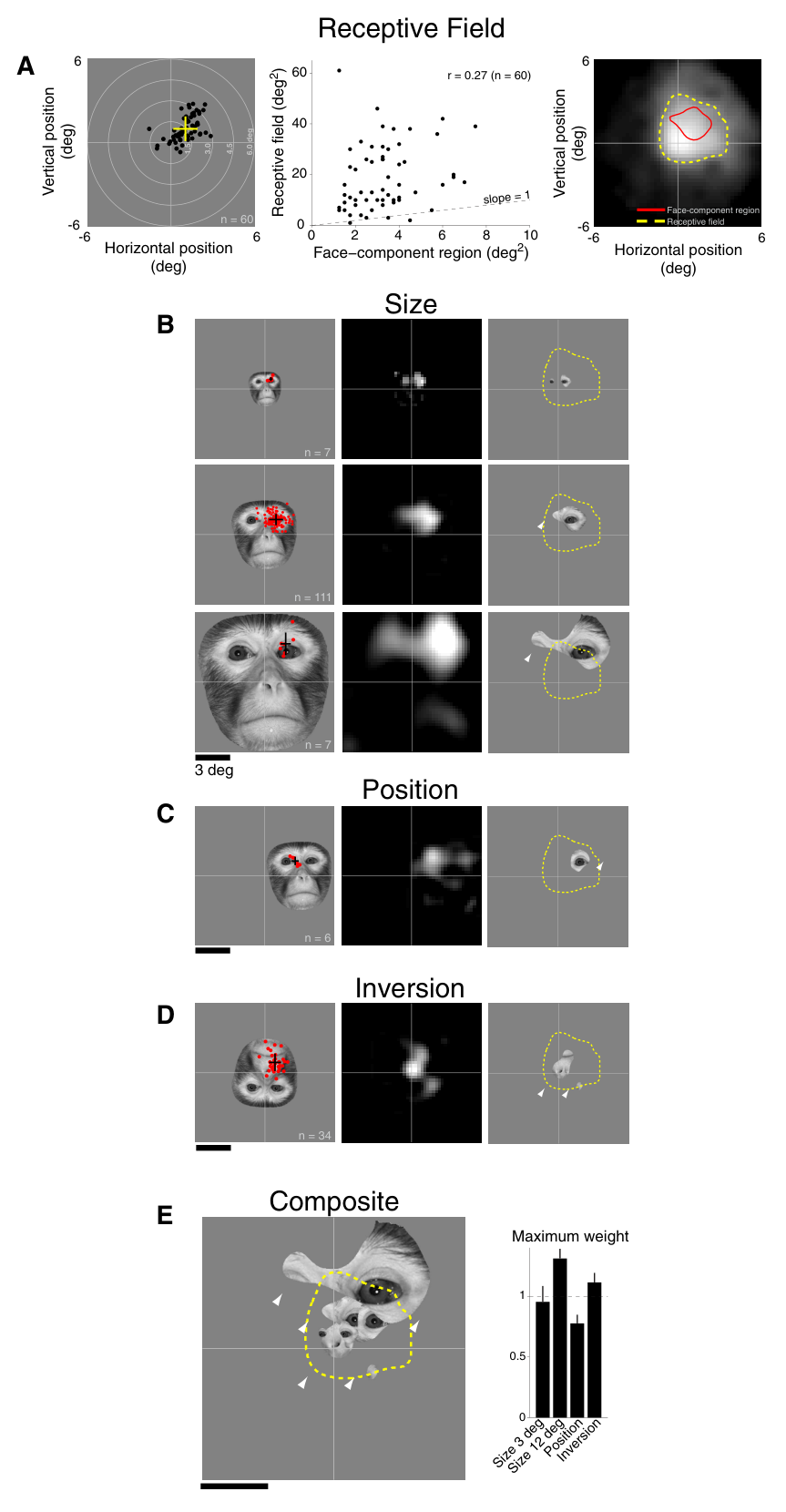
图 8 · 部件的线性贡献与早期线性求和
原文图注:Figure 8. Linear contribution of face outline and contralateral eye. A, The linear contribution of each human-segmented face part (right eye, left eye, nose, or mouth) when testing all possible combinations(2^4=16totalimages)inthecontextofafaceoutline.B,Correlationofpartpreference(i.e.,wpart/∑|wi|)withfaceselectivityindex.C,Themedianresponseofthe population to all possiblepartcombinationswherethepresenceoftheoutlinewasalsovaried(2^5−1=31totalimages)plottedagainstthesumoftheresponsestotheparts(verticalbars,SDofresponsesacross thesitestested;horizontalbars,SDofthesumofpartsresponsesacrossthesitestested;triangles,single-partresponses;squaresymbols,whole-faceresponsevsthesumoftheresponsestothefive parts). Prior to averaging across sites, the responses for each site were rescaled by the average response to the whole face.
A:对轮廓固定、四个部件(右眼/左眼/鼻/嘴)有无全部 16 种组合做线性回归,对侧眼的权重最大,轮廓次之(轮廓权重即回归截距)。B:部件偏好(w_part/Σ|w|)与 FSI 的相关——眼偏好与脸选择性挂钩,轮廓偏好者的 FSI 明显更低(上四分位均值 0.97 vs 0.59);眼权重与轮廓权重负相关(r=−0.75),提示独立输入。C:31 种组合(轮廓有无也变动)下,响应(纵轴)对部件响应之和(横轴)作图——早期窗(0–40 ms)的数据点几乎落在对角线上(噪声校正相关中位数 0.95,n=32),晚期窗(41–80 ms)整体偏离对角线且"五部件之和"方块远高于"整脸"方块,呈亚线性。此图支撑主要结果第 4 条,是"早期局部线性、晚期非线性"结论的核心证据。
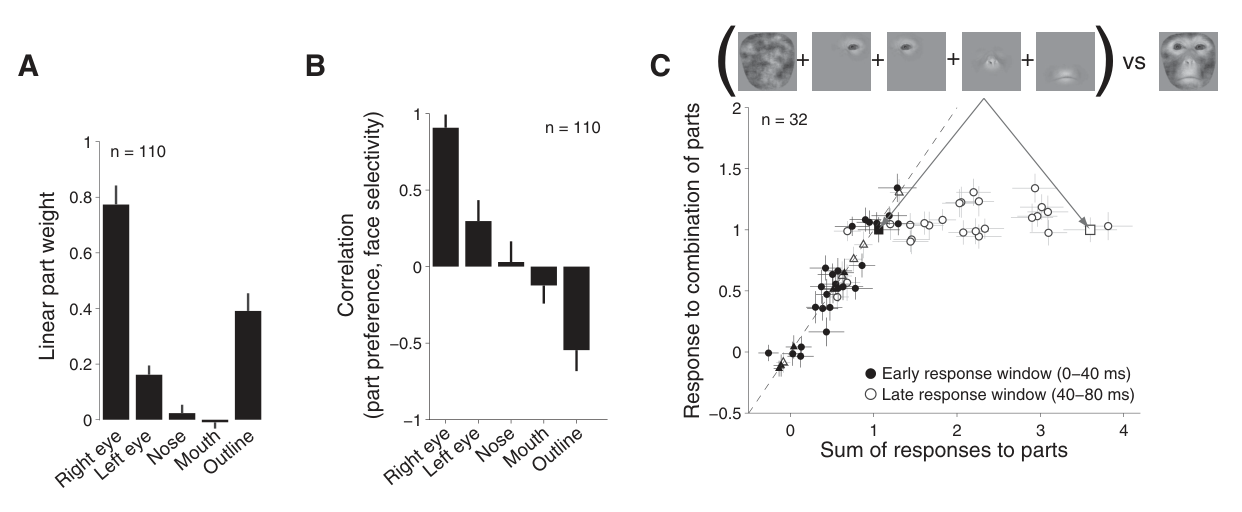
图 9 · 视网膜位置控制:眼是位置无关的偏好特征
原文图注:Figure9. Effectofretinalpositiononresponsestofaceparts.A,Population-averageresponsestothefaceparts(eye,nose,and mouth)testedatninepossiblepositionsonthefaceoutline(theresponsetotheoutlinealonewassubtracted,andresponseswere normalized by the median outline-subtracted response to the whole face). B, Bottom, Color histogram showing the responses of individual sites to the eye, nose, and mouth presented at nine different positions. Sites are ordered by their position preference (blackboxes)followedbytheirfeaturepreferenceatthepreferredposition(i.e.,eye-selectivesitesappearfirstfollowedbynose- and then mouth-selective sites). Responses are thresholded at half-maximum (see color legend).
A:把眼、鼻、嘴分别放到脸轮廓上九个可能位置(减去仅轮廓的响应并归一化)后的群体平均响应——只有眼处于对侧位置时响应最大,鼻在上对侧位置的响应弱于眼,嘴在上对侧位置几乎无响应。B:每个位点对三部件×九位置的响应热图(按位置偏好排序,再按偏好位置上的特征偏好排序,阈值取半最大)——在各个对侧视野位置上,多数位点都偏好眼(眼作为最大驱动部件:65% 位点,鼻 25%,嘴 10%)。此图支撑主要结果第 5 条中的位置控制:眼偏好在视网膜位置变化下依然成立。
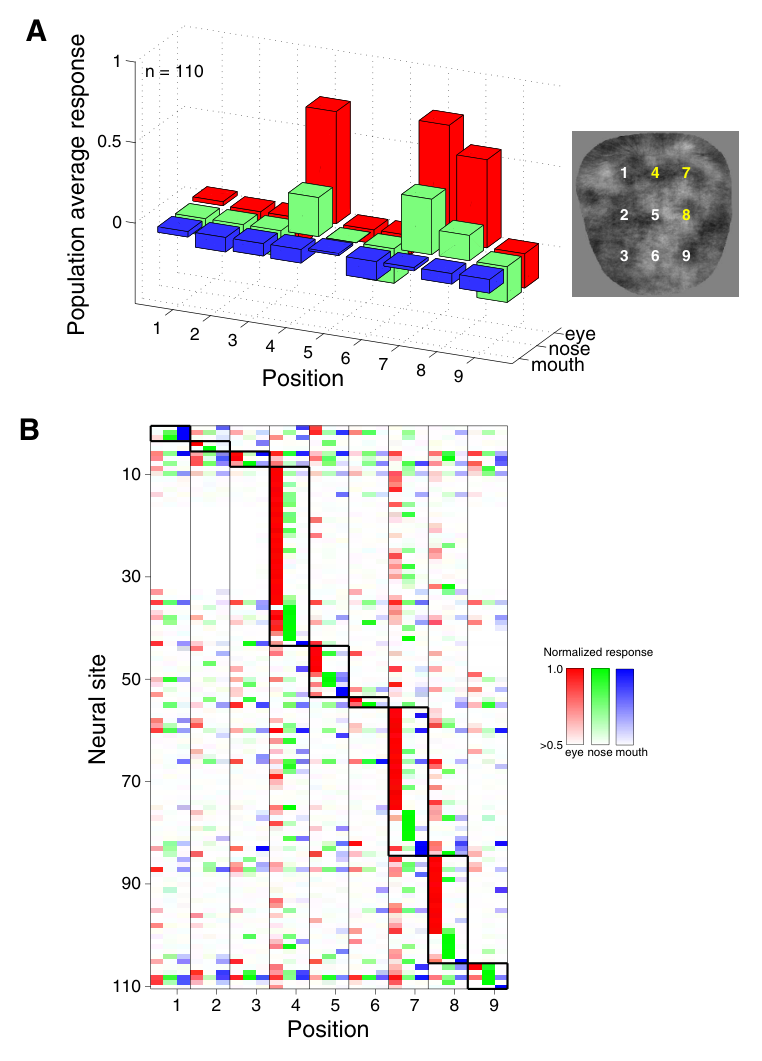
图 10 · 与"是不是脸"脱钩的预测性刺激
原文图注:Figure 10. Images predicted to drive early responses in PL. A, Left, Responses to images containing some or all of the face parts in the context of the face outline. Right, The outline-relative positionoftheeyecouldbevariedacrossawiderangeandstilldriveearlyresponsesinPLsites.Thewhitesquareindicatessthefixationpointwhennotonthecenteroftheimage.Insets,Responses oftwoexamplesitestothesameimages.B,Reducedearlyresponsesforfaceswerefoundwhenahorizontalorverticalbaroccludedthecontralateraleye.Insets,Responsesoftwoexamplesitesto horizontallyorverticallyoccludedfaces.C,Top,PLresponseswerepoorlypredictedbywhetherafacewaspresentorabsent(faceconsideredpresentifatleasthalfofthefaceisvisibleandabsent otherwise).Bottom,PLresponseswererelativelywellpredictedbywhethereye-likefeatureswereintheuppercontralateral visual field.RawaverageofindividualsiteresponsesshowninAandB were rescaled by the median response to the whole face. Dashed lines indicate the median response to nonface objects.
A:左——完整脸、缺右眼的脸(响应很弱,尽管人看它仍是脸)、只有右眼+轮廓(响应接近整脸);右——眼在轮廓内大幅变换位置(甚至偏离轮廓中心、加上注视偏移补偿)都能强烈驱动早期响应。B:水平/垂直灰条遮挡对侧眼区使早期响应明显下降,遮挡其他区域无此效应。C:上——按"脸在场/缺席"(至少半张脸可见)分组时群体响应分不开;下——按"眼样特征是否在上部对侧视野"分组时响应泾渭分明(虚线为对非脸物体的中位响应)。此图是主要结果第 5 条的直接证据,也是全文最"打脸"直觉的一组图。
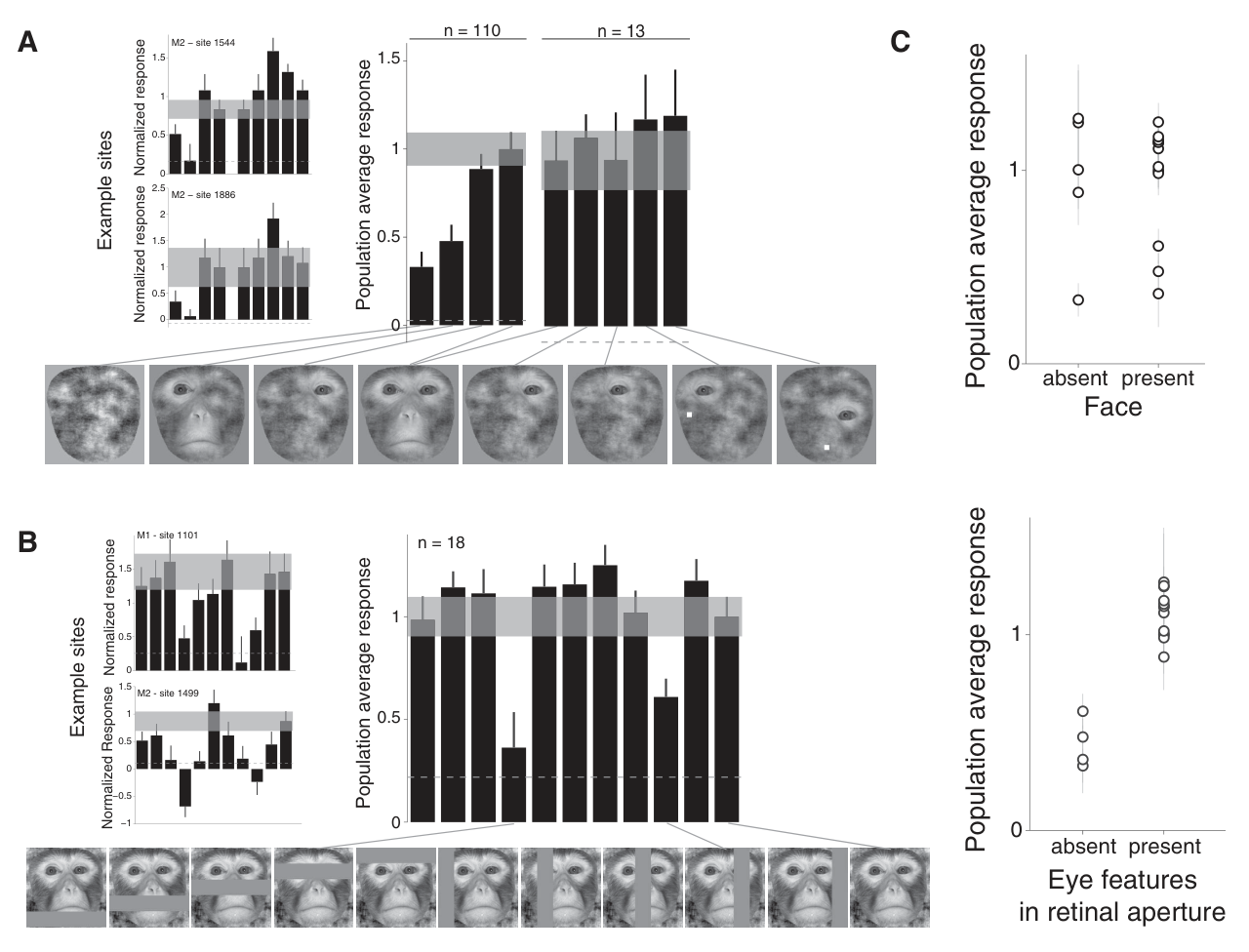
图 11 · 单单元对眼缺失/遮挡的响应
原文图注:Figure11. Responsesofsingleunitswhentheeyeregionwasabsentoroccluded.A,Single-unitresponseswerehighestwhen aneyewaspresentintheupper,contralateralfieldandwerestronglyreducedwhenthecontralateraleyewasabsent,eventhough all other face parts were present. B, Single-unit responses were strongly reduced when both eyes were occluded and weakly reduced when the contralateral eye was occluded.
A:51 个单单元的群体平均响应——眼在上部对侧视野时最高,去掉对侧眼(其余部件齐全)后强烈下降。B:12 个单单元——双眼均被遮挡时响应强降,仅遮挡对侧眼时弱降(另一只眼仍留在孔径内的部分贡献)。此图证明眼区主导效应在单单元水平成立(主要结果第 6 条),排除了多单元平均的疑虑。
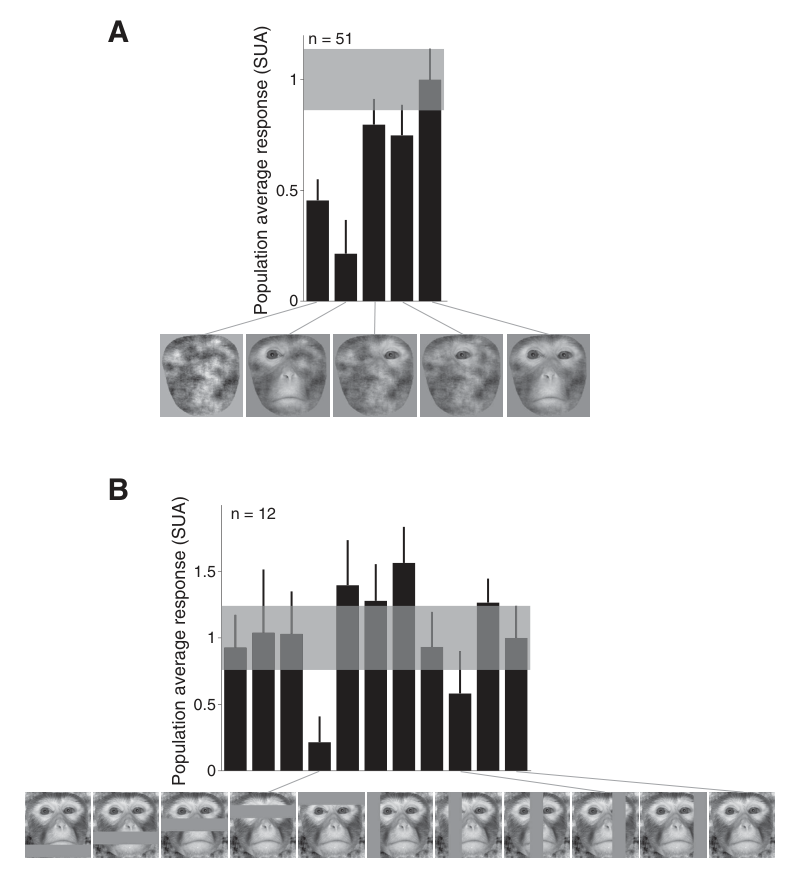
图 12 · 潜伏期证据:眼区决定响应快慢
原文图注:Figure12. Responselatencywhentheeyeregionwasabsentoroccluded.A,Simplypresentingtherighteye(darkgray)butnottheoutline(lightred)ledtoaresponselatencyasshortasfor the wholeface(black).Removingtherighteyedelayedresponsesevenwhenalloftheotherfacepartswerepresent(darkred).Insets,Responselatenciesintwoexamplesitesforthesamesetofimages. B, Latency increased when occluding the contralateral eye region using a horizontal or vertical bar (red) but not when occluding other regions of the face (gray). Insets, Response latencies of two examplesitestohorizontallyandverticallyoccludedimages.A,B,Right,Population-averagedPSTHsshownrescaledbythemedianresponsetothewholefaceat100ms.IndividualsitePSTHswere aligned by their minimum latency to faces, bodies, objects, or places before averaging.
A:单独呈现右眼的潜伏期与整脸一样短(不需要轮廓加速);去掉右眼(其余部件齐全)则响应延迟约 10 ms;各位点 PSTH 按各自最短潜伏期对齐后取群体平均。B:用水平或垂直条遮挡对侧眼区增加潜伏期,遮挡面部其他区域无影响。此图支撑摘要与讨论中的关键句——"仅缺眼的脸引起更长潜伏期响应",并与人类心理物理中遮挡眼区延长反应时(Fraser et al., 1990;Lewis and Edmonds, 2005)、遮挡别处无效的结果对齐。
讨论
作者的解读是:PL 早期响应可由"眼样特征 + 边界曲线,两者在视网膜孔径内独立输入、线性求和"这一简单模型解释,因此把 PL 细胞当作"整脸检测器"并不恰当,基于部件(parts-based)的视角更贴近事实;轮廓的存在虽可被引用为整体加工的证据,但眼与轮廓单独即可强驱动、线性求和、无需自然构型、且偏好不同位点(负相关),更像是两路独立输入的加法。作者特别区分了早期与晚期:早期(头 40 ms)局部、线性、以视网膜为中心;晚期(40–80 ms)则出现对鼻、嘴等其他部件的响应与亚线性整合,与 ML 的既有发现一致,说明"整脸"性质可能在后续阶段或别的通路(如 STS 面孔补丁、甚至当前定义的脸网络之外)涌现。他们还与人类文献对话:人类 FFA 中"只有眼睛"并不比"无眼的脸"驱动更强的 BOLD(Tong et al., 2000),但 BOLD 积分的是秒级信号,与本研究的毫秒级早期窗并不矛盾;PL 更可能对应人类枕叶面孔区(OFA)——对侧眼足以驱动 OFA 的早期诱发电位(N170)与 MEG 响应,与本文平行。生态学上,PL 偏好区域的平均视网膜位置(方位 1.04°、仰角 0.99°)恰好对应约 1 m 距离处直立面孔回望时眼所在的位置(注视先落在鼻上),暗示系统 specialized 到真实观看统计;眼区驱动快速检测也与脸检测比其他类别更快的神经与心理物理证据一致,并与 Viola–Jones 检测器依赖眼区特征的计算方案趋同。作者承认的局限:只用了"眼样""轮廓"这样的描述词代理真实图像偏好,尚未给出图像可计算的定量模型;"眼样特征"与"轮廓"的精确形式、对比、位置、尺寸依赖关系仍待确定;晚期非线性加工的性质留给未来。
一句话总结
这篇最让我佩服的是论证的收尾方式:先从数据反推出一个朴素到近乎"土"的模型(孔径内一只眼加一段弧线,线性相加),再用这个模型主动预言几种反直觉刺激的结果,最后让刺激替自己说话——"缺眼的脸弱、独眼的脸强"两组图一摆,任何整脸模板理论都必须退让。如果承认 PL/OFA 这一环是零件级的特征检测,那么"脸"这个知觉概念是在链条上游哪里、以什么机制涌现出来的,就成了后续十年面孔加工研究的真正问题;而本文之所以常被引用,正是因为它把这个问题的起点钉得足够牢。
审校与证据追溯 (Verification & Evidence)
图表审计结果
- Fig1: 提取质量
good,对齐度full,识别面板[A, B] - Fig10: 提取质量
good,对齐度full,识别面板[A, B, C] - Fig11: 提取质量
good,对齐度full,识别面板[A, B] - Fig12: 提取质量
good,对齐度full,识别面板[A, B] - Fig2: 提取质量
good,对齐度full,识别面板[A, B] - Fig3: 提取质量
good,对齐度full,识别面板[A, B, C] - Fig4: 提取质量
good,对齐度full,识别面板[A, B, C] - Fig5: 提取质量
good,对齐度full,识别面板[A, B] - Fig6: 提取质量
good,对齐度full,识别面板[A, B] - Fig7: 提取质量
good,对齐度full,识别面板[A, B] - Fig8: 提取质量
good,对齐度full,识别面板[A, B, C] - Fig9: 提取质量
good,对齐度full,识别面板[A, B]