IT Literature Intelligence 终审版本 (VERIFIED) 论文编号:
290| 原始基线:V0_ZCODE_BASELINE| 语义审核:needs_revision| 图表审核:minor_issueAstra裁决:compromise_revision(revise)
Visual neurones responsive to faces in the monkey temporal cortex
Perrett · Experimental Brain Research · 1982 · Zotero itemID=2464
这是猴颞叶"面孔细胞"(face cells)的早期系统性研究之一:在 3 只清醒猕猴的上颞沟(superior temporal sulcus, STS)沟底记录了 497 个单细胞,从中分离出至少 48 个对面孔选择性反应的神经元,并用几何图形、杂物物体、唤醒/厌恶性刺激、变换视角的面孔、遮蔽五官等一整套对照实验逐一排除"唤醒""情绪""简单特征感受野"等平庸解释。它值得读,是因为本文示范了单细胞电生理如何回答"一个神经元究竟在编码什么"这一问题,其对面孔构型敏感性的发现(正常排布强于打乱排布)是后来面孔知觉研究长期沿用的思路起点。
研究背景
面孔模式加工在当时已是热点:一方面,很小的婴儿就能对面孔模式表现出差异化的反应(Goren 等 1975;Meltzoff 与 Moore 1977),提示面孔加工出现极早;另一方面,局限性脑损伤可以只破坏面孔识别(面容失认症,prosopagnosia)而基本不损及其他物体的知觉(Meadows 1974;Whiteley 与 Warrington 1977),提示面孔加工有相对独立的神经机制。但面孔模式分析乃至一般复杂模式分析的脑机制在当时完全未知——电生理层面尚没有对面孔反应作系统对照检验的研究。
作者团队(Rolls 实验室)在做视觉辨别学习相关的神经元活动研究时偶然注意到:猴颞叶一个特定区域——STS 沟底皮层——存在对"看见面孔"反应、却对实验辨别刺激或其他刺激不反应的细胞(Perrett 等 1979 及未发表数据)。表面上的视觉选择性可能来自多种途径:唤醒、情绪或运动反应、某种简单视觉特征、感受野设置等等。本文的目标就是把这些候选解释逐一分流,搞清这批细胞选择性的真正基础,并借机推进对视觉信息加工及其脑损伤后障碍的理解。
研究思路
整体策略是"最大化对照面":既然面孔细胞最容易用非视觉解释搪塞过去,作者就把每一种替代解释都变成一个可测的实验条件。刺激库极其庞杂——高对比方波光栅、条纹与斑点等几何图形,收集了超过 1000 个尺寸、形状、颜色、表面纹理各异的"杂物"三维物体,真人面孔与照片、投影面孔,以及用以诱发唤醒的听觉/触觉/视觉厌恶性刺激(气吹、羽掸、逼近物体、蛇与蜘蛛模型、食物、手和白大褂等"人类"线索)。接下来用系统性变换逼近"编码的不变量"问题:改变呈现时长、观察距离(20 cm 至 2 m 以上)、颜色滤片(红绿蓝等 Wratten 滤片)、同构旋转(水平/倒置)、转向侧面(profile);再用遮蔽与单独呈现五官检验"部分还是整体";最后用线描面孔与剪贴照片特征做正常排布对打乱排布(jumbled)的构型实验。每一步都在问同一个问题:这个细胞还认不认这张脸?
方法
3 只清醒雄性猕猴(4.5-6.5 kg)坐于猴椅中,用玻璃绝缘钨丝微电极记录单细胞活动,PDP11 在线分析;电极轨迹用 X 光片定位,记录末端做组织学验证的微损毁以重建细胞位置——5 个面孔选择性单元的记录位点经组织学确认位于 STS 沟底皮层。实验程序上,猴子先训练视觉辨别任务:看到 S+ 舔出获得果汁奖励,看到 S- 不舔以避免厌恶性高渗盐水;辨别刺激从快门(开启时间小于 15 ms)后伪随机呈现,快门在 700 Hz 信号音 0.5 s 后开启 1.0 s,测试刺激随机穿插其间且不被强化。用贴在脚底的银/氯化银表面电极记录皮肤电反应(galvanic skin response, GSR)以量化唤醒程度,用眼电图(electro-oculogram, EOG)确认注视,注视不良的试次从分析中剔除。分析窗口为快门开启后 0.1 s 起的 0.5 s 内发放,直方图给出典型 4-10 次呈现的均值与标准误。变换条件包括:色滤片、距离/尺寸、水平或倒置的同构旋转、把实验者头部或玩具黑猩猩头转 90°成侧脸(视线始终朝正前方);遮蔽实验用 1 cm 杆、1 cm 缝、2 cm 方孔、6 cm 直径半圆孔等屏幕限制猴子的可视部分;构型实验用透明胶片上画好的线描五官(三角三点鼻子、双圆眼睛、同心点瞳孔、细栅格头发、带弧线的牙齿行)做正常或旋转 90/180/270°打乱的排布,另用黑白面孔照片上剪下的真实五官贴到正常或错误位置。
主要结果
- 记录位点与细胞构成:在 STS 沟底及上壁 2-3 mm 内共记录 497 个细胞(位于耳间平面前方 5-11 mm),其中至少 48 个为面孔选择性细胞,另有 49 个对面孔有反应但数据不足以确认选择性基础;其余 207 个有视觉反应的细胞多数(98 个)偏好运动刺激(图 1)。面孔细胞以兴奋性放电为主,潜伏期 80-180 ms(图 2),92%(44/48)呈持续性放电;对 100-300 ms 的短呈现,放电精确锁定刺激的起始、时长与结束(图 3)。
- 反应一致且不习惯化:面孔反应在长达 1-3 小时的记录期内稳定可重复(图 4);快速连续重复呈现时,23 个测试细胞中仅 5 个出现反应下降倾向。
- 非面孔解释被系统性排除:面孔反应比光栅、几何图形或复杂三维物体大 2-10 倍(图 5);对听觉(22 个测试细胞中仅 2 个短暂反应)、触觉(21 个中 5 个弱短暂反应)基本无反应,对厌恶性视觉刺激(44 个测试)虽 GSR 更大却反应更弱(图 6);面孔奖励化或惩罚化不改变反应大小;行为反应(咂嘴、龇牙等)的类型与强度和神经元放电无对应关系(12 个细胞检验)。
- 变换视角下反应高度耐受(图 7):76%(26/37)的细胞对面孔照片 vigorous 反应,颜色滤片仅使 18 个测试细胞中的 1 个略降;14 个细胞在 20 cm 至 2 m 以上观察距离(图像尺寸相差约 10 倍)下反应恒定;21 个细胞对水平/倒置旋转反应等同。唯一大幅影响反应的变换是转向侧面——32 个测试细胞中 21 个被明显削减或消除(图 8),部分细胞甚至转 10-20°即显著下降。
- 五官部分与构型敏感性:多数细胞在遮住部分或半张脸时仍能反应,但 35 个细胞中眼睛对 23 个(测试 31 个)、头发对 21 个(测试 41 个)、嘴部对 18 个(测试 25 个)有效;不同细胞的特征组合互不相同,多数细胞对整脸的反应大于任何单独部分(图 9、10)。构型上,一个细胞对"同心圆+点"的眼刺激反应良好、对结构被破坏的两个圆或两个点不反应(图 11 上);另一细胞对正常排布线描面孔的反应显著大于打乱排布(t=5.3, df=13, P<0.001,图 11 下);照片剪贴特征实验中 3/4 的细胞偏好正确排布,其中一个细胞正常对打乱 t=3.98, df=19, P<0.001,1/4 尺寸的面孔上仍成立(t=4.03, df=4, P<0.02,图 12)。多数细胞对人和猴、熟悉与陌生面孔都反应。
图注解读
图 1 · 面孔反应细胞的解剖定位
原文图注:Fig. 1. Anatomical location of cells responding to faces. Left Outline drawing of lateral view of left hemisphere of rhesus monkey brain. The stippling along the superior (sup) temporal sulcus indicates the range in anterior/posterior position (5-11 mm anterior to the interaural plane) over which cells responsive to the sight of faces were recorded. Right Outline drawing of brain structures evident in a coronal section of the brain of one monkey taken 8 mm anterior to the interaural plane. The positions of 18 cells recorded in this monkey within 1 mm of the plane of the section are reconstructed
左图为猕猴左半球外侧面轮廓,上颞沟沿线的点阴影标出面孔反应细胞记录的前后范围(耳间平面前方 5-11 mm);右图为一只猴耳间平面前方 8 mm 处的冠状切面轮廓,重建了该切面 1 mm 范围内记录到的 18 个面孔细胞的所在位置。这张图确立"面孔细胞在哪里"——集中在 STS 沟底、靠近 von Bonin 与 Bailey 分区 TA 与 TE 交界处——是后面所有细胞属性讨论的解剖坐标,对应结果第 1 条。
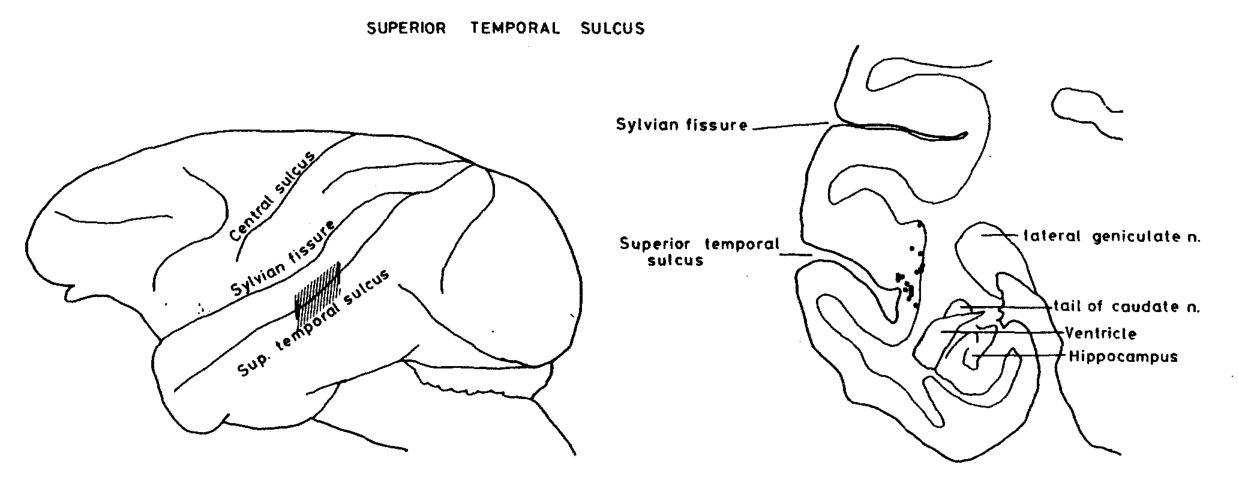
图 2 · 反应潜伏期分布
原文图注:Fig. 2. Response latencies of the neurones in the cortex in the fundus of the STS which responded selectively to faces
横轴为反应潜伏期(80-160 ms 刻度),纵轴为细胞数量,直方图汇总面孔选择性细胞的视觉反应潜伏期分布。读图要点:全部为兴奋性反应、潜伏期集中在 80-180 ms 之间(正文数值),与 STS 其他视觉细胞相当。这个"既不太快也不太慢"的分布有两重作用:排除运动/情绪解释(那类反应潜伏期应更长且更不稳定),同时说明面孔信息在这层皮层已完成相当程度的视觉整合,对应结果第 1 条与讨论的论证 (1)。
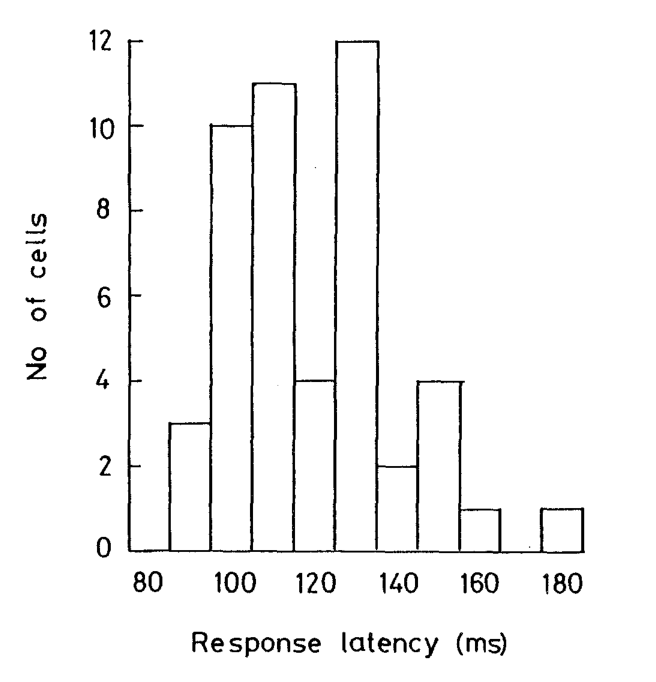
图 3 · 不同呈现时长的反应栅格图
原文图注:Fig. 3. Visual responses of an STS cell to faces presented for different lengths of time. Each dot represents the occurrence of one or more action potentials in a 10-ms time bin. Each horizontal row of dots represents data from a single trial. Data from different trials which originally occurred in random order have been rearranged for the display. During visual discrimination trials, the monkeys gave a lick (L) response to one of two stimuli, which were presented from behind a shutter at time zero after a 0.5-s signal tone. Time relative to the opening of the shutter is shown along the horizontal axis. The cell recorded was unresponsive to the sight of the discriminative stimuli but gave a large sustained excitatory discharge when the shutter opened to reveal the face of the experimenter
逐试次栅格图(raster):每点代表 10 ms 时间仓内的一次或多次动作电位,每行一个试次,横轴为相对快门开启(0 时刻)的时间。各行按条件分组:视觉辨别试次中细胞对辨别刺激(标注 L 的舔反应)无反应,而快门开 revealed 实验者面孔时出现大幅持续放电;下方几行显示面孔呈现 1.0 s、0.3 s、0.1 s 时放电随之只持续相应时长。这张图给出"放电与刺激锁时、随呈现时长缩放"的最直观证据,是排除运动/情绪反应的论证 (1) 的原始数据。
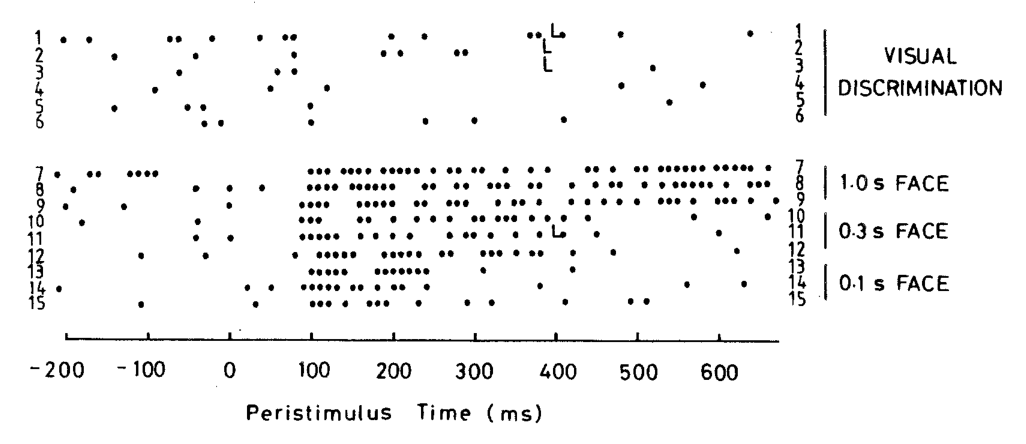
图 4 · 3 小时内反应的一致性
原文图注:Fig. 4. Consistency of responses to a face over the testing period. Format is as for Fig. 3. Columns at the right side give the total number of spikes occurring on each trial in the time periods 100-300 ms and 100-600 ms after shutter opening. All rows of dots represent activity from trials (over a 3-h period) on which the face of the experimenter was presented
格式同图 3 的栅格图,但所有行都是 3 小时记录期内呈现实验者面孔的试次,右列给出每试次在快门开启后 100-300 ms 与 100-600 ms 两个时段的总发放数。读图要点:各试次发放数有波动(如 49、24、50、37 等)但始终可观,说明面孔反应稳定可重复、不随时间迅速习惯化。这支撑结果第 2 条"反应一致且不习惯化",把"偶然反应"或"状态波动"的解释挤掉。
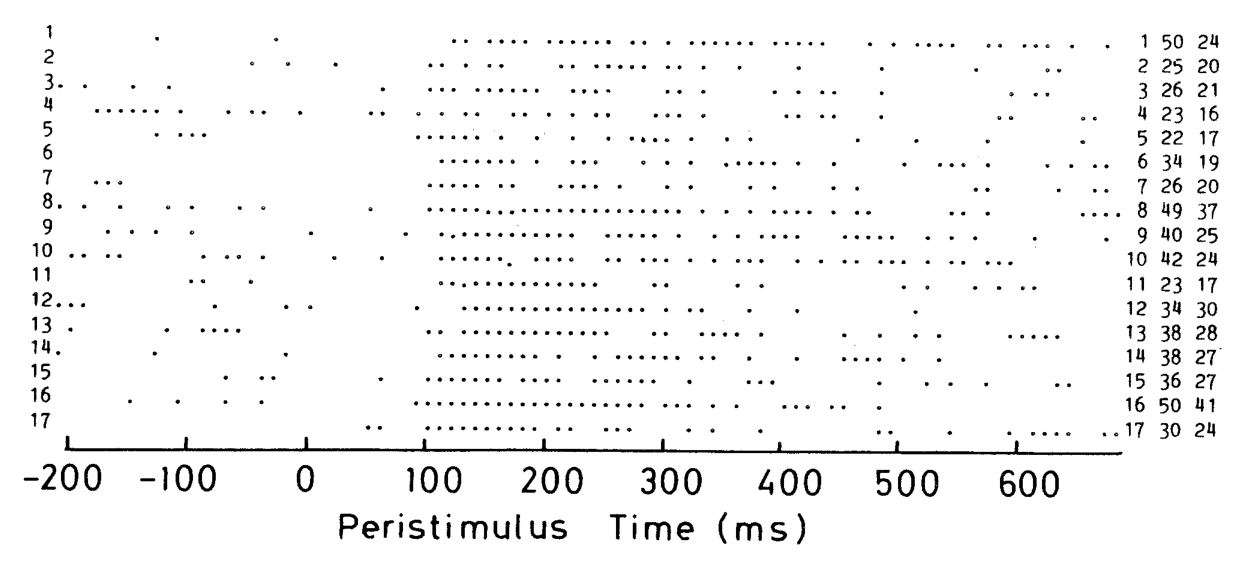
图 5 · 视觉选择性直方图
原文图注:Fig. 5. Visual selectivity. Histogram of the mean (+/- the standard error) of the responses (spikes/s) for one cell are given for different stimuli relative to the cell's spontaneous firing rate. This cell gave large excitatory responses to the sight of faces but did not respond to the sight of simple geometrical stimuli such as bars and square wave gratings or to more complex three-dimensional objects. The cell was unresponsive during somatosensory stimulation (stroking the legs) and to auditory stimuli (loud noises made out of sight)
单细胞直方图:纵轴为相对自发率的平均发放(spikes/s,附标准误),横轴依次列出各刺激类别(面孔、几何图形、三维物体、体感刺激、声音等)。读图要点:只有面孔一柱显著高于自发率线(Spontaneous),其余各类几乎贴着基线。这是"面孔选择性"最直接的单细胞画像,量化了结果第 3 条中"面孔反应大 2-10 倍"的典型个体案例。
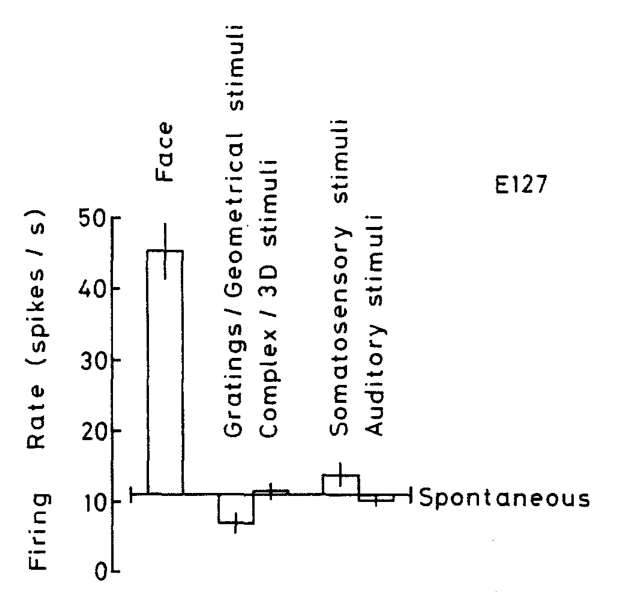
图 6 · 唤醒性刺激不诱发反应
原文图注:Fig. 6. Arousing stimuli. A comparison of the responses of one cell to the sight of faces and arousing or interesting visual stimuli. The mean and standard error of the responses (spikes/s) are given for the different stimuli relative to the cell's spontaneous firing rate. The cell responded well to the face, but not to the sight of aversive stimuli (such as an air puffer) or to stimuli moving towards the monkey (looming stimuli). The cell also did not respond to stimuli with human meaning (such as a hand) or to the sight of food
仍是单细胞直方图,比较面孔与各类唤醒/有趣视觉刺激:厌恶性刺激(气吹)、逼近物体(looming)、带"人类"含义的刺激(手)、食物等。读图要点:面孔柱高高在上,其他刺激即便能诱发可靠的 GSR 也只引起微弱或零反应。这张图是"唤醒解释不成立"论证 (2) 的图示版——生理唤醒更大并不等于神经元放电更强,对应结果第 3 条。
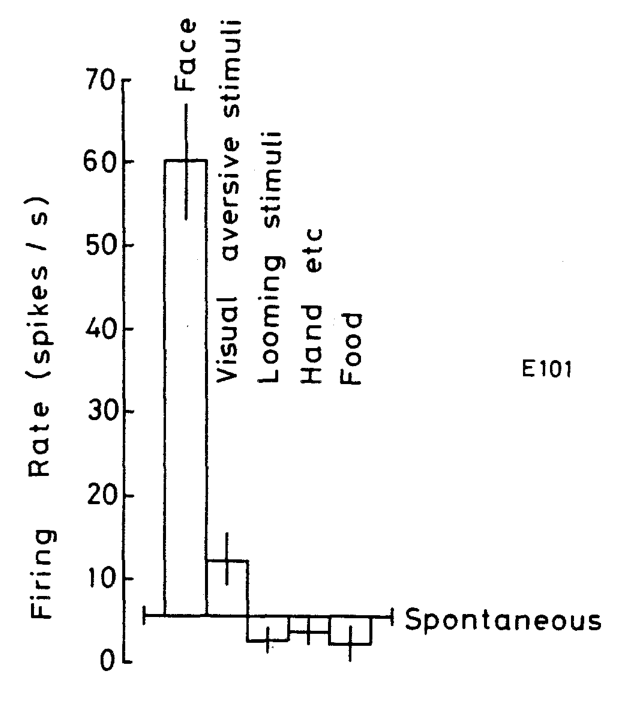
图 7 · 变换视角下面孔反应的耐受性
原文图注:Fig. 7. Transformed faces. The mean and standard error of the firing rate (spike/s) for one STS cell are given relative to spontaneous activity for different views of faces. From top to bottom: experimenter's face at a distance of 2 m, experimenter's face viewed through red, green and blue colour filters, experimenter's face upside down, experimenter's face in profile
单细胞直方图,自上而下依次为:2 m 距离的面孔、红/绿/蓝滤片下的面孔、倒置面孔、侧脸(profile)。读图要点:前四类变换后反应仍与正常观察条件相当(2 m、三色滤片、倒置都保持高发放),最后一类(侧脸)明显下降。这一"耐受大多数变换、唯独怕侧脸"的画像同时给出不变性与敏感性的边界,对应结果第 4 条。
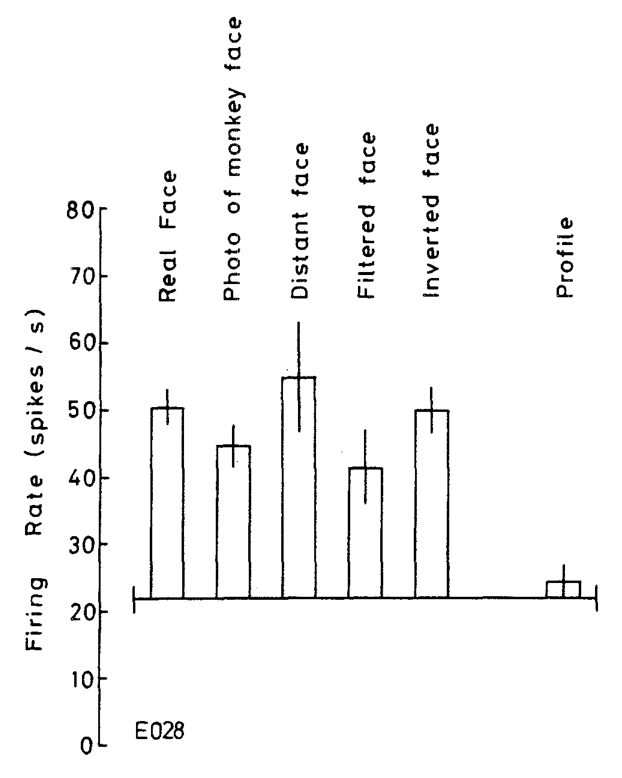
图 8 · 侧脸旋转的逐试次栅格图
原文图注:Fig. 8. Responses to face profile. Format as Fig. 3. Activity of one STS cell on individual trials (originally occurring in random order) is displayed on separate lines. For each trial the angle (to the left or right) of the stimulus face toward profile, away from full face, is given in the column on the right
栅格图,每行一个试次,右列标注该试次面孔从正脸向左或右转向侧面的角度。读图要点:正脸(0°附近)时放电密集,偏离哪怕一个小角度发放即骤减,逐试次对照清晰显示角度-反应的单调关系。这是"转向侧面会削减或消除 21/32 个细胞反应"这一结果最戏剧性的个案展示,支撑结果第 4 条与讨论中"正脸具有社会信号意义"的猜想。
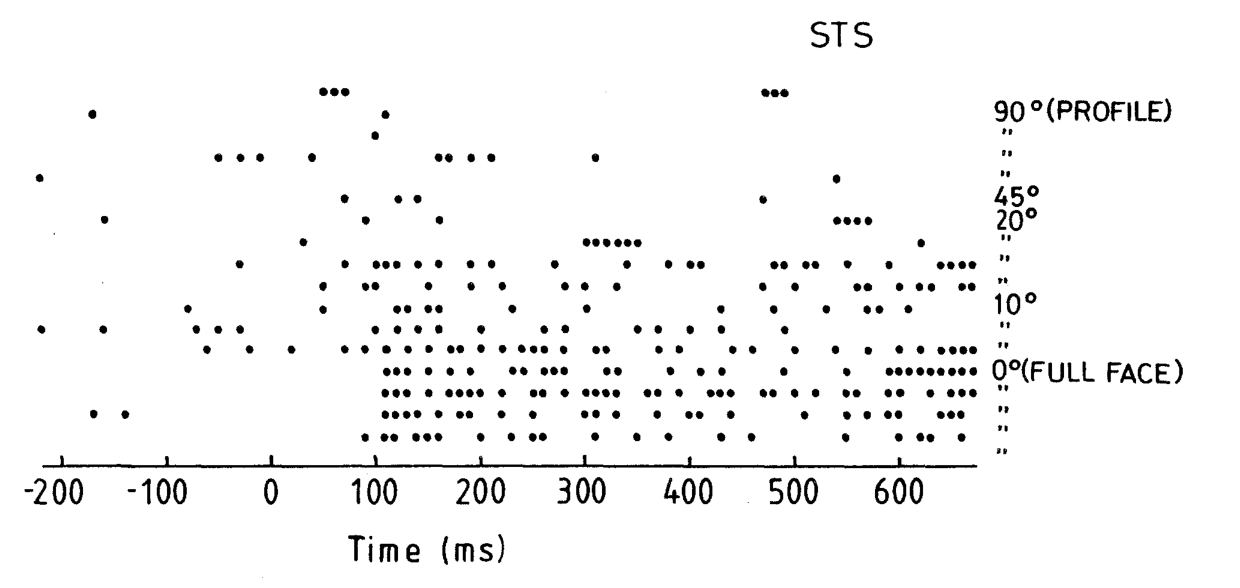
图 9 · 眼睛:必要还是充分?两个细胞的相反行为
原文图注:Figure 9 illustrates the effects of covering up the eyes or covering the rest of the face for two cells. For the cell on the right side, the presence of the eyes was necessary, and responses were reduced when a bar was placed over them. Consistent with this, presentation of the eyes alone in a slit view elicited a good response from the cell. Thus, for this cell, the eyes were a sufficient and necessary stimulus for the cell to respond. This behaviour is opposite to that of the cell on the left side which responded equivalently to the whole face and to the face with the eyes obscured, and failed to respond when only the eyes were viewed through the slit. Thus, for the left, the eyes were neither a necessary nor a sufficient part of the face to produce the response found to the whole face.(截断)
两个细胞(E127 与 E122)的直方图并排比较:横轴列出整脸、遮住眼睛的脸、缝中只看眼睛等条件,纵轴为相对基线自发率的平均发放。读图要点:右侧细胞(E122)遮眼即失活、缝视眼睛即恢复——眼睛既必要又充分;左侧细胞(E127)恰好相反——遮眼照常反应、只看眼睛不反应(它实际响应嘴部与头发)。这组镜像对照是结果第 5 条"不同细胞依赖不同特征子集"最清晰的表达。
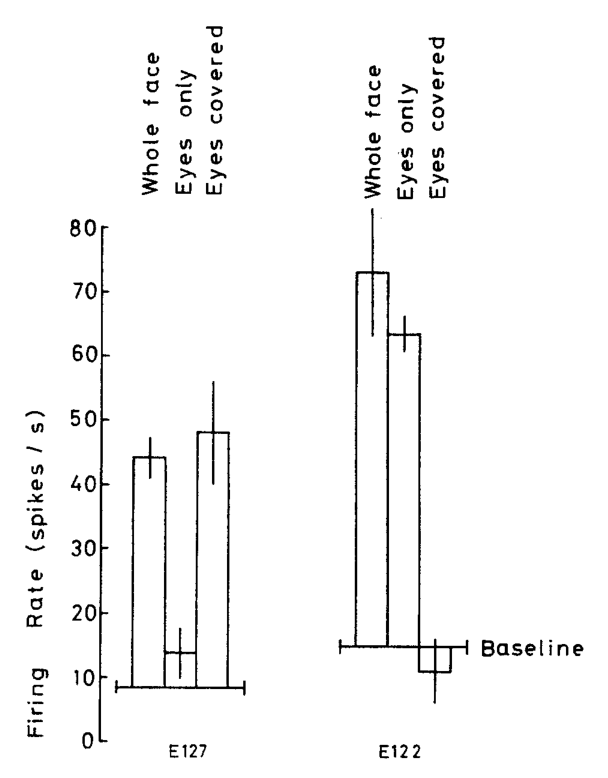
图 10 · 四个细胞对整脸与五官的反应剖面
原文图注:Figure 10 illustrates the different behaviour of four cells to face parts. For the cell at the top, a single eye, hair and mouth were ineffective individually in producing responses; the cell did, however, give a good response to the whole face. Cells on the second and third lines responded mainly to one of the facial features tested. The cell on the second line responded quite well to the mouth, whereas the cell on the third line responded more to the eye. The cell on the bottom line responded well to several of the features tested.
四行直方图各对应一个细胞,横轴为整脸、单独的眼/头发/嘴部与对照视觉刺激,纵轴为高于基线的平均发放(各细胞刻度已归一化,整脸柱等大以便比较)。读图要点:第一行细胞只认整脸、任何单独部件无效;第二行偏好嘴部,第三行偏好眼睛,第四行对多个部件都有反应——即"需要全部特征""依赖单一特征""对多个特征均可"三种类型并存。这直接支撑结果第 5 条关于特征依赖异质性的结论。
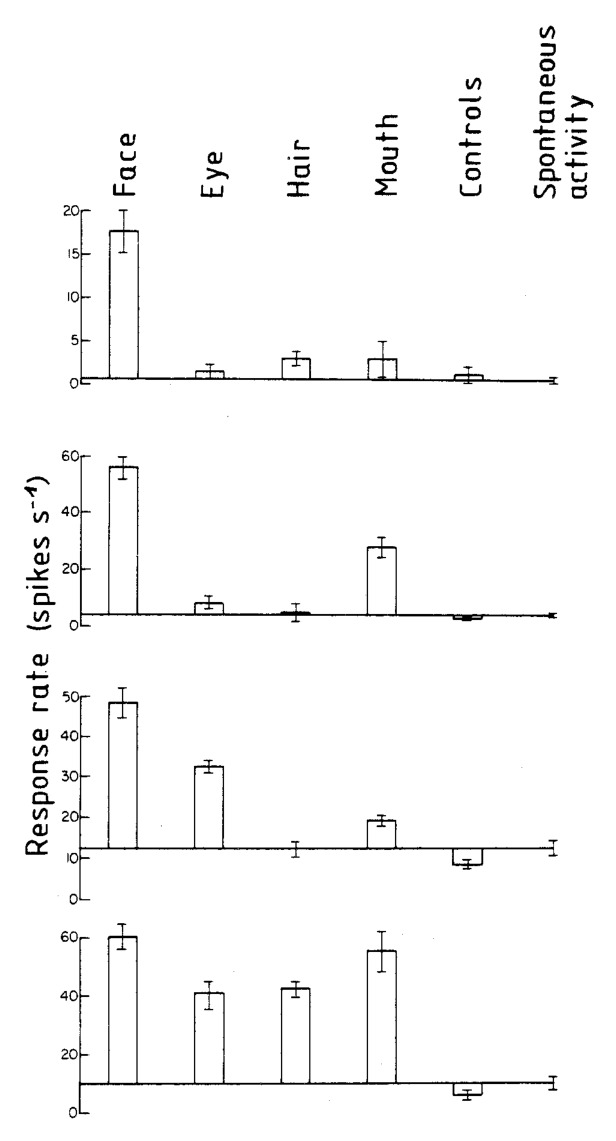
图 11 · 线描面孔:局部结构与整体构型
原文图注:Fig. 11. The effects of the local structure and general organization of line drawn face stimuli. Upper part. Format as Fig. 3. The right-hand columns give for each trial the total number of spikes occurring in the 250-ms and 500-ms time periods, commencing 100 ms after shutter opening. The responses of one cell to a line drawn face are compared to the responses of individual line drawn features. This cell responded well to the eye stimuli, a horizontal pair of concentric circles and dots, but failed to respond when the concentric structure was destroyed and two circles or two dots were presented alone. Lower part. The responses of a different cell to a line drawn face are compared to the responses to the same lines jumbled into three disorganized patterns (A, B and C). When the lines were organized into a face pattern, responses were significantly larger. The last two lines of the figure illustrate the larger responses of this cell to the sight of a real face or a real eye
上下两部分各为一个细胞的栅格图(右列给出每试次 100-500 ms 时段的发放总数)。上半部分:该细胞对线描眼(水平同心圆与点对)反应良好,同心结构被破坏、只呈现两个圆或两个点时反应消失;下半部分:另一个细胞对组织成面孔图案的线条反应显著大于同一线条的三种打乱排布(正常对打乱 t=5.3, df=13, P<0.001),且对真脸、真眼的反应(最后两行)又远大于线描。这张图把选择性从"面孔这个类别"推进到"特征的局部结构与整体构型",对应结果第 5 条的构型部分。
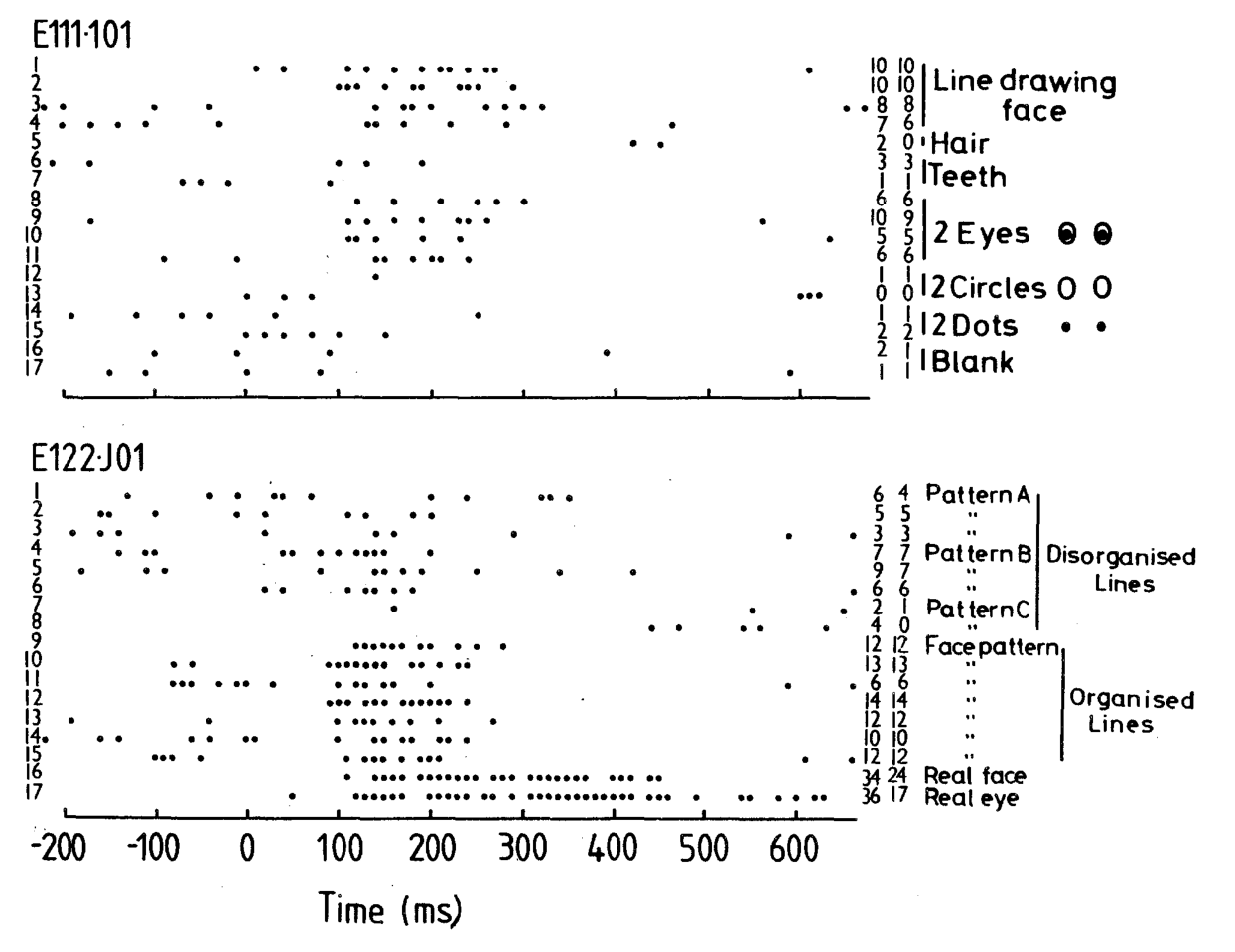
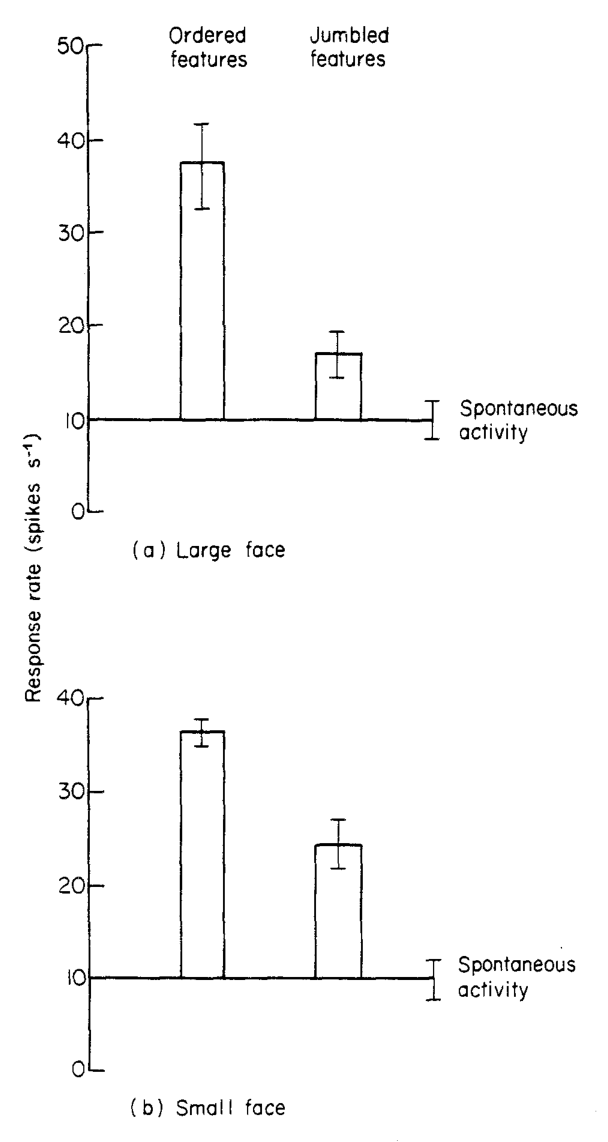
图 12 · 正常排布对打乱排布(照片剪贴特征)
原文图注:Fig. 12. The mean and standard error of the responses (spikes/s) to the normal and jumbled arrays of face features for two faces. The upper figure gives the mean responses for several different jumbles including jumbles symmetrical about the vertical axis. The lower figure compares responses to one jumbled array for a face one quarter of the size of that used in the upper figure
两个直方图:上半为较大面孔,比较正常排布与多种打乱排布(包括关于垂直轴对称的打乱)的平均反应;下半为 1/4 尺寸的小面孔,比较正常排布与一种打乱排布。读图要点:无论哪种打乱(含对称打乱)反应都低于正常排布(大面孔 t=3.98, df=19, P<0.001;小面孔 t=4.03, df=4, P<0.02),且效应在尺寸缩小后仍成立。这排除了"反应取决于线条复杂度或局部并置"的解释,支持细胞对面孔构型本身的敏感,对应结果第 5 条。
讨论
作者的论证分三步走。先排除非视觉解释:(1) 放电与刺激锁时且随呈现时长缩放,提示感觉性本质——若是运动或情绪反应,潜伏期应更长更不稳定且会溢出刺激时长;(2) 唤醒刺激的 GSR 更大却诱发更弱放电,行为反应与放电亦无对应;(3) 不同细胞依赖不同特征子集,唤醒解释无法容纳这种异质性。再刻画编码属性:这批细胞对面孔的多种成像条件(颜色、尺寸、二维照片、旋转/倒置)高度耐受,选择性基于"表征面孔存在"的复杂视觉属性;与它们相对照,其他视觉系统(包括向 STS 沟底提供输入的下颞皮层)的细胞大量对朝向、颜色、纹理特异(Gross 等 1972;Rolls 等 1977)。倒置耐受与人类的倒置效应(Yin 1969)并不矛盾——这些变换不妨碍"把刺激看成一张脸",而单个细胞编码的是面孔部分/特征的存在而非特定个体,群体层面则可能传递个体特异信息。侧脸敏感性被联系到社会意义:正脸凝视在猕猴中可作威胁姿态(Hinde 与 Rowell 1962)。最后是功能关联:STS 沟底接收下颞皮层输入、向杏仁核-顶叶-额叶发出投射,作者提出面容失认症(人类枕颞下部损伤)与 Klüver-Bucy 综合征中的驯化与社交障碍(杏仁核损伤后无法对面孔作出恰当反应)可能与这一面孔加工系统的损毁或失连有关——该区向杏仁核的重度投射与杏仁核内面孔反应细胞的发现支持这一猜想。局限方面,作者承认未测量感受野(引用麻醉猴的测量提示该区感受野大、双侧、含中央凹),也承认面孔细胞偏侧化问题因取样偏向左半球而未定;与 Bruce 等(1981)记录的 STS 背侧壁多感觉区 7 个面孔细胞相比,本区细胞潜伏期更短(80-180 ms 对 200-300 ms)且不是多感觉的。
一句话总结
读这篇文章最大的感受是"排除法做得干净":唤醒、情绪、运动、简单特征、感受野逐项配对检验之后,面孔构型敏感性才站得住脚。我认为它的历史地位在于把"面孔是不是特殊类别"从争论变成了可测的神经编码问题——本文通过多组对照刻画了STS面孔选择性细胞的反应性质:部分单细胞对某些面孔特征或特征组合敏感;作者进一步推测,这类细胞的群体活动可能携带个体身份信息,但本文未直接检验该假说。,这个层次结构几乎预言了此后四十年面孔加工研究的全部框架。
审校与证据追溯 (Verification & Evidence)
图表审计结果
- Fig1: 提取质量
good,对齐度full,识别面板[] - Fig10: 提取质量
good,对齐度full,识别面板[] - Fig11: 提取质量
good,对齐度full,识别面板[A, B, C] - Fig12: 提取质量
good,对齐度full,识别面板[] - Fig2: 提取质量
good,对齐度full,识别面板[] - Fig3: 提取质量
good,对齐度full,识别面板[] - Fig4: 提取质量
good,对齐度full,识别面板[] - Fig5: 提取质量
good,对齐度full,识别面板[] - Fig6: 提取质量
good,对齐度full,识别面板[] - Fig7: 提取质量
good,对齐度full,识别面板[] - Fig8: 提取质量
good,对齐度full,识别面板[] - Fig9: 提取质量
good,对齐度full,识别面板[]
关键事实与局限性声明
- 审校纠偏: {'classification': 'OVERCLAIM', 'claim': '图2的潜伏期分布能够排除运动或情绪解释', 'problem': '作者的论据是短时呈现条件下反应与刺激起止锁时、GSR与行为反应对照等证据的组合,而不是潜伏期分布本身单独完成排除。', 'recommended_fix': '表述为“潜伏期及锁时特征支持反应具有感觉性;结合GSR和行为对照,使纯运动或情绪解释不太可能”。'} -> 评注:
- 审校纠偏: {'classification': 'OVERCLAIM', 'claim': '打乱构型实验排除了线条复杂度或局部并置解释,并证明细胞编码面孔构型本身', 'problem': '实验说明正常组织方式是重要因素,且结果不能简单归因于线条总复杂度;但打乱操作同时改变多个空间关系,不能排除所有低级视觉差异,而且效应只见于少量受测细胞。', 'recommended_fix': '表述为“少数细胞对正常空间组织比打乱组织反应更强,支持其对面孔特征构型敏感”。'} -> 评注:
- 审校纠偏: {'classification': 'INTERPRETATION', 'claim': '正脸偏好反映面对面凝视的社会意义', 'problem': '这是作者基于猕猴威胁凝视行为提出的解释,本文没有操纵社会意义或直接测量威胁判断。', 'recommended_fix': '明确标注为作者推测,而不是实验证实的功能机制。'} -> 评注:
- 审校纠偏: {'classification': 'INTERPRETATION', 'claim': '该STS系统的损伤或失连导致面容失认、Klüver–Bucy综合征及社交障碍', 'problem': '本文是相关性的单神经元记录,没有实施STS损毁、可逆失活或因果干预;临床及杏仁核联系只能支持候选功能关联。', 'recommended_fix': '改为“作者提出该系统可能为面孔识别及社会情绪系统提供输入,其损伤或失连可能参与相关障碍”。'} -> 评注:
- 审校纠偏: {'classification': 'OVERCLAIM', 'claim': '这个层次结构几乎预言了此后四十年面孔加工研究的全部框架', 'problem': '这是无法由本文数据检验的历史性夸张,也抹平了后续研究对身份、表情、视角、动态面孔、网络组织和因果机制的实质扩展。', 'recommended_fix': '改为“该研究较早提出了从局部特征、特征组合到群体表征的研究问题,对后续面孔神经机制研究具有重要启发意义”。'} -> 评注:
- 补充要点: : (第 333 页)
- 补充要点: : (第 335 页)
- 补充要点: : (第 334 页)
- 补充要点: : (第 340 页)
- 补充要点: : (第 330 页)