IT Literature Intelligence 终审版本 (VERIFIED) 论文编号:
193| 原始基线:V0_ZCODE_BASELINE| 语义审核:needs_revision| 图表审核:pass
A Brain Network Processing the Age of Faces
Homola · PLOS One · 2012 · Zotero itemID=1807
一句话定位:这篇文章首次用 fMRI(功能磁共振成像)加 DWI(扩散加权成像)定位了加工"面部年龄"的脑网络。作者让 24 名被试观看连续人脸渐变视频(morphing),把年龄变化与性别变化在刺激上正交分离,发现双侧后下颞沟(pITS)与后角回(pANG)对年龄变化特异性响应,且两者由鲜为人知的 Wernicke 垂直联合纤维束腹侧部(WpF)相连。它值得读,一是因为把"年龄"从人脸加工经典网络中剥离出来、提出"脸敏感节点 + 非物体特异的量化模块"的组合模型,二是其"激活概率 vs 结构连接概率"的空间交叉相关方法本身就是结构—功能关系研究的一个范例。
研究背景
面部年龄是一种被作者称为"不瞬时可变"(not volatile)的面部属性——它不像视线、口型或表情那样随注意与情绪随时变化,而是像性别、种族一样属于"固定但可变"的发育性线索。尽管人脸加工已被广泛研究,年龄这一维度却从未被专门的神经影像实验定位过:既往形态渐变(morph)研究中,年龄要么不被变化、要么被当作需要控制的干扰变量。已知的是,Haxby 等提出的分布式人脸加工系统区分了"核心系统"与"扩展系统",Bruce & Young 与 Ellis 的认知模型则把年龄和性别都归为"视觉引导的语义编码";临床数据提示年龄判断与性别判断可能分离——面孔失认症患者识别年龄和性别通常不受累,而"年龄识别失认但性别保留"的病例尚未见报道。面部年龄由皮肤质地、与平均头形偏距等复杂特征与构型刻画,还有研究提示它可能涉及与数量感、时间流逝计算相关的网络。
缺口在于三个具体问题:(i) 面部年龄与性别的转变是否调用不同的功能网络?(ii) 哪些年龄响应区与个体年龄判断能力相关?(iii) 年龄响应区的激活模式是否与其结构连接模式相关?另外年龄在面孔中的显著性本来就低于性别和种族(发展心理学的证据),需要用能放大年龄参数的刺激来"增强"其加工。作者选择性别而非身份、吸引力等作为对照条件,理由是性别分化随年龄变化、复杂度与衰老相当,且性别与年龄都是"可量化但非瞬时可变"的属性,二者可用同一套连续渐变范式公平比较。
研究思路
作者的总体策略是"连续渐变 + 参数化建模 + 功能/结构双重验证"三条链。第一,用全可形变三维模型(FaceGen)渲染 120 段连续人脸渐变视频,使年龄变化与性别变化在时间上相互正交(两个回归元的 Pearson 相关仅 r = 0.046, p = 0.39),渐变本身又免去了显式基线的需要,还能借助运动增强脸敏感区的响应并减少适应。第二,先做心理测量学标定再进模型:把主观年龄梯度评级拟合到史蒂文斯幂定律(Stevens' law),用实测幂指数 0.3 构造年龄回归元、用幂指数 3 构造性别(两性同体 androgyny)回归元,并把光流(optical flow,由 Horn-Schunck 算法估计)作为全局干扰变量纳入 GLM,以剥离低层构型/特征变化的贡献。第三,用概率纤维追踪(probabilistic tractography)在功能聚类之间追踪白质通路,再以"激活概率与连接分数的逐顶点空间交叉相关"检验连接是否真的参与该条件的加工——如果 A-B 连接的空间轮廓能预测 A 的激活轮廓,就说明这条通路可能确实承载了条件相关信息;同时用 46 名独立被试的 DWI 做外部重复。
对照条件的选择也有讲究:性别加工应落在经典的梭状回(FFG)/梭状面孔区(FFA)一带,若本范式中性别结果能复现既往静态刺激研究的结论、而年龄结果落到别的区域,则"检测到的是年龄网络而非其他不稳定特征"这一结论就有了内部锚点。
方法
24 名健康右利手白人志愿者(23–34 岁,均值 26,SD 3;12 名女性)分两次完成扫描:第一次采集 fMRI 与 T1 解剖像(3T TimTrio,12 通道线圈;改为“丢弃最初4个扫描后,分析了350个全脑BOLD EPI体积(volumes)”。);两周内的第二次采集全脑 DWI(1.5T,60 个弥散方向,b = 1000 s/mm²)并做事后行为评级。刺激为 121 张陌生人正面照片(2–81 岁,均值 33;男女各半,表情中性、无妆饰)经三维可形变模型生成的 120 段渐变视频:每段 6 秒渐变加 1 秒静止帧,随机顺序单次呈现共 14 分钟;一半渐变含性别转换。任务只是当被试预期到目标脸出现时按键以维持注意,其响应不被分析(受执行与运动共激活污染)。女性被试统一在月经周期第 5–15 天扫描。
分析流程用 FSL 4.1 与 FreeSurfer 4.5.0:一阶 GLM 建模三个解释变量(年龄变化、性别变化、光流),按心理测量学结果用 Stevens 幂律参数化(年龄幂 0.3、性别幂 3,均取一阶导数的绝对值),并纳入时间导数以捕捉微小偏差;使用 FEAT 的 FILM 预白化,fsl_motion_outliers 检出的运动离群值作为混杂回归元。二阶分析在 fsaverage 表面上做混合效应 GLM,非参数置换聚类推断加 Bonferroni 校正,只报告全族错误率(FWER)校正 p < 0.05 的结果,坐标给到 MNI 空间。DWI 用 bedpostx 建模每体素最多两个纤维方向(应对交叉纤维),probtrackx 以功能聚类为种子做种子—目标概率追踪(每点发出 10^4 条样本,加停止/路点掩膜排除间接路线),连通性以到达目标顶点的连接样本数计分;年龄评级能力按评级误差分成上五分位(最准者 n = 5)、平均组(n = 14)与下五分位(n = 5,因依从性差被排除),用于与 fMRI 响应幅值关联。
主要结果
- 心理测量标定:主观年龄梯度评级最符合 Stevens 幂律(幂指数 0.3,优于 Weber-Fechner 对数或自然对数变换);随客观年龄增大,主观年龄评级在 24 名被试间的变异(SD)也增大;对真实脸与算法插值的"虚拟脸"的年龄评级精度无显著差异(p = 0.97)。性别评级沿渐变时程高于线性过渡值,反映知觉层面的性别范畴化倾向,幂指数为 3(图 2A–C)。
- 年龄变化特异性激活:双侧后角回区(pANG,下顶叶 PG 区/BA39)与后下颞沟(pITS,PH 区/BA37)显著激活(FWER 校正 p < 0.05;改为“左pANG团块面积2309 mm²,峰值统计量−log10(p_uncorrected)=8.739;团块水平多重比较校正后CWP=0.0001”。,左 pITS 526 mm²,右 pANG 1177 mm²,右 pITS 367 mm²)(图 4A、表 1)。年龄(而非性别)条件在左半球激活更强(条件×半球交互 p = 0.04,ANOVA)(图 4B)。
- 光流(干扰变量)如预期激活双侧运动敏感区 hMT+(图 1C),性别变化则激活双侧梭状回(FFG)、右外侧枕颞区(LOT)与左背外侧前额叶(DLPFC)(图 4A、表 1)——改为“性别条件复现既往结果,为范式有效性提供内部参照,并降低但不能排除年龄效应来自其他随渐变变化因素的可能性”。。
- 年龄评级能力与脑响应:左 pANG 内 STS 上方的一个亚团块把最准的 5 名评级者与平均组(n = 14)区分开;高准确组在隐式年龄加工中的左 pANG 响应幅值约为平均组的近 5 倍(>4 倍,p < 0.001),注明“低五分位组未纳入主要二级组间分析;其图示响应变异较大,与平均组的非显著差异只能作为描述性结果”。(图 4C、D)。
- 结构连接及其与功能的耦合:概率纤维追踪发现连接 pANG 与 pITS 的是 Wernicke 垂直联合纤维束的腹侧部(WpF);两半球间连合连接可忽略(<0.1% 样本到达目标)。逐顶点空间交叉相关显示,pANG 与 pITS 之间激活概率与连接分数的正相关在所有聚类对中最稳定一致(pANG 激活最强的顶点邻近 pITS 连接最强的顶点);改为“独立DWI样本(n=46)大体复现了pANG–pITS结构连接轮廓,并在与主要样本功能激活图的空间相关中得到相似结果;这不是独立fMRI重复”。,后者相关略强(图 5、图 6)。右半球 pANG–LOT 也存在较低的正相关(r = 0.10–0.18)。
图注解读
图 1 · 渐变刺激、光流与 hMT+ 激活
原文图注:Figure 1. Continuous face morphing, optical flow and associated functional activations. (A) Exemplary keyframes of a video sequence (see Movie S1) morphing a 20 year-old female into a 60 year-old male. Both gradual age and gender changes are illustrated at intervals of 1 second. (B) Line magnitude images of optical flow velocities computed by the Horn-Schunck algorithm. Differential motion/optical flow was quantified as an overall parameter by the sum of flow magnitudes between successive keyframes. (C) Motion-/flow-related activations of hMT+ derived from the group-level analyses (n = 24 subjects, FWER-corrected p<0.05, [−2log10 (p)] colorbar) on posterior cortical flat maps of both hemispheres. Additionally, ventral (v) and dorsal (d) visuotopic labels (V1–8, Vp, LO, hMT+) of the SuMS database, transformed from Caret's PALS atlas into FreeSurfer's average surface space, are displayed. Note that according to recent data [112], V4v and V8 are labeled together as hV4 while VP has been labeled V3v.
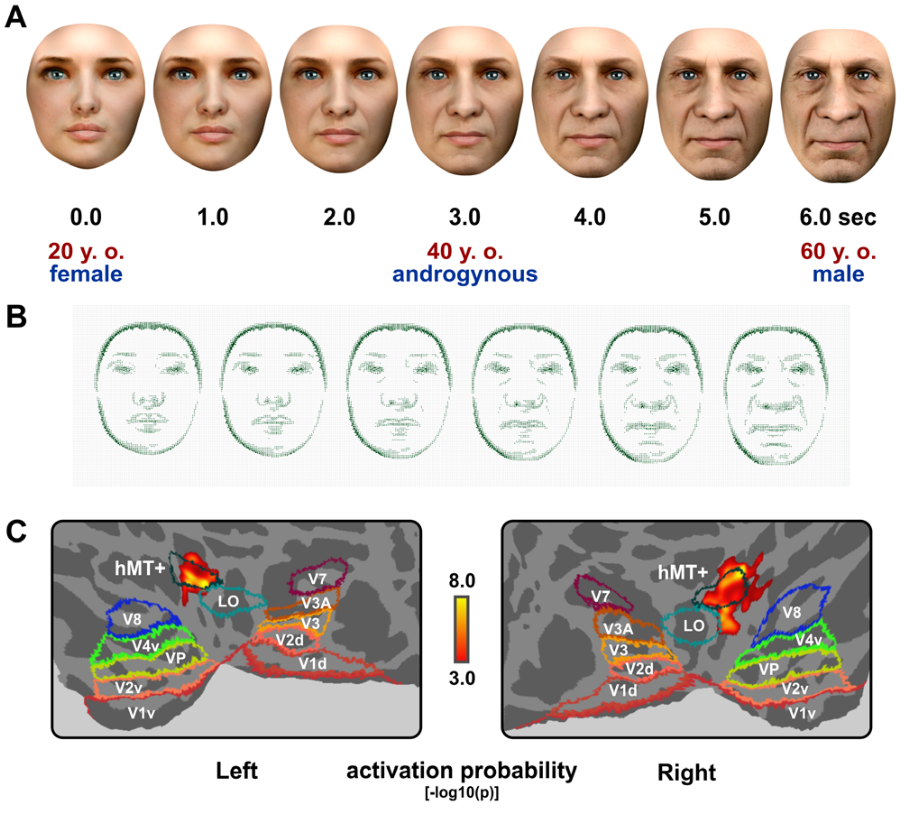
解读:三联图给出整个范式的基础。(A) 展示一段 20 岁女性渐变为 60 岁男性的视频关键帧,年龄与性别同步连续变化;(B) 是 Horn-Schunck 算法算出的光流速度线幅值图,逐关键帧求和得到全局运动量;(C) 把光流作为干扰回归元得到的激活投射到双侧皮层平坦图上,与 hMT+ 图谱标签空间吻合。这张图证明两件事:刺激是"看着自然"的真实渐变,以及低层运动信号被成功分离并定位到运动区——后面所有年龄/性别激活的特异性都建立在这个对照之上。
图 2 · 年龄与性别的心理测量学
原文图注:Figure 2. Psychometrics of facial age and gender changes. (A) Facial age difference ratings (magnitude of age-gradients spanned by morphing rated on a 6-point visual analogue scale, maximum scaled to 3.0 arbitrary units [a.u.]) followed Stevens' (<0.3) better than Weber-Fechner's law (log10) or a natural logarithmic transformation (ln) of start and target age. All face stimuli (n = 121) were morphed to an average-aged male face of 33 years, the morphing sequence was randomly played forwards or backwards for the rating (circles with error bars; n = 24 subjects). (B) Facial aging (x-axis; objective age in [years]) increased the variability of subjective age ratings (y-axis; SD, standard deviation of estimated age in [years] across n = 24 subjects). Rating accuracy of factual (n = 121 stimuli of real faces) and interpolated age (n = 80 intermediate face stimuli from the morphing algorithm; one randomly selected for each annual increment between 2 and 81 years of age) did not differ significantly (p = 0.97). (C) Face gender ratings (on a 6-point visual analogue scale, maximum scaled to 1.0 arbitrary units [a.u.]) along temporal morph continua (n = 60) across faces of clearly different sex. Subjective ratings by (n = 24) subjects (boxes with error bars, blue line) were augmented above linear transition values (dashed line with black dots), reflecting the tendency to apperceptive gender categorization.
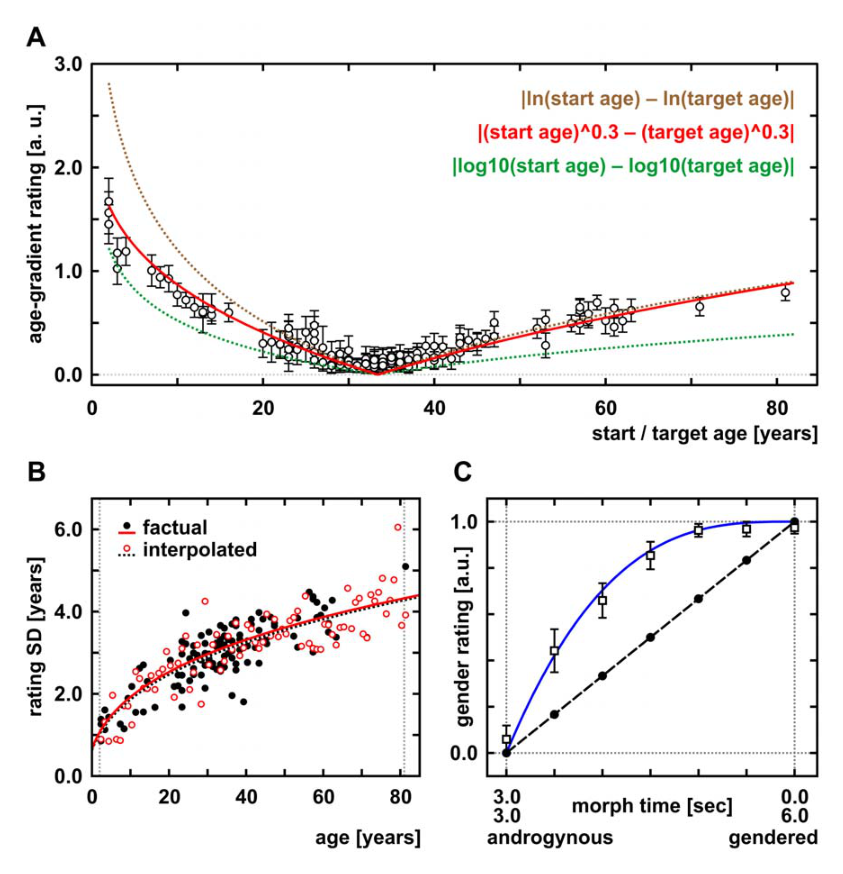
解读:三幅小图分别回答三个标定问题。(A) 主观年龄差评级(纵轴,6 点模拟量表)随起点—目标年龄差的函数关系:0.3 次幂变换拟合最好,据此构造 fMRI 的年龄回归元;(B) 横轴客观年龄、纵轴被试间评级标准差,年龄越大评级分歧越大,且真实脸与插值脸精度无差(p = 0.97),为"插值虚拟脸可作为有效刺激"背书;(C) 沿渐变时程的性别评级高于线性过渡(蓝实线高于黑点虚线),支持性别幂指数取 3。这张图是方法学的地基:fMRI 建模参数不是拍脑袋定的,而是先测出来的。
图 3 · 年龄与性别回归元的时间模型
原文图注:Figure 3. Modeling changes of age and gender during face morphing. Both were time-binned at the video frame rate (24 fps) and scaled to maxima of 1.0 arbitrary units [a.u.]. (A) Differential age change encoded according to Stevens' law of psychophysics (using a power exponent of 0.3; Figure 2A). Note that relative facial aging was up-weighted to initial periods of the example morph (also see Figure 1A; here: solid red line) and, for identical age differences, to younger absolute ages, i.e. aging from 10 to 26 was assumed to provide a stronger stimulus with more visual cues than aging from 64 to 80 years (dashed vs. double-dotted/dashed line). (B) Differential gender change expressed by the first derivative of the function plotted in Figure 2C. Note that peak androgyny was defined as the effective stimulus-of-interest, i.e. the transition of facial gender was emphasized at the center of the morph (see also Figure 1A and Movie S1). Half of the morphs contained no gender transitions, retaining a flat line at zero level to indicate the lack of gender change (dashed line).
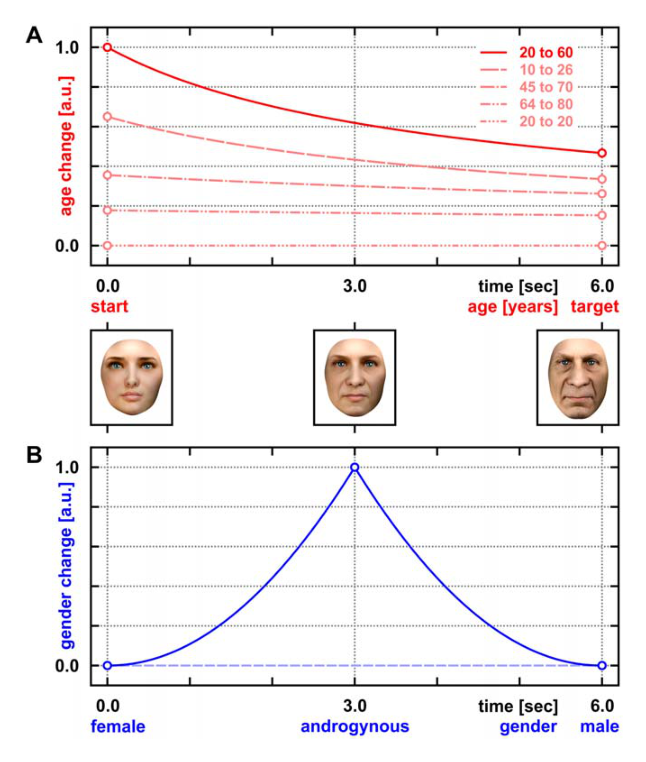
解读:这张图把图 2 的心理物理函数变成逐帧(24 fps)时间回归元。(A) 实红线示例一段渐变中年龄变化被加权到前段与更年轻的绝对年龄段——同样从 10 岁变到 26 岁比 64 岁变到 80 岁提供更强的视觉线索;(B) 性别变化取两性同体水平函数的一阶导数,峰值两性同体(peak androgyny)位于渐变中点,即性别转换的"最模糊时刻"才是有效刺激;无性别转换的渐变保持零水平线。读懂这张图才能理解"年龄网络 vs 性别网络"两个对比在 GLM 里到底比的是什么。
图 4 · 年龄与性别激活及评级能力效应
原文图注:Figure 4. Functional activations associated with changes of facial age and gender. (A) Group-level (n = 24) functional activations related to age and gender change, respectively. (B) Quantification and between-cluster/-hemisphere comparisons of observed effect sizes evoked by facial age and gender changes across (n = 24) subjects. Individual values of each cluster's mean activation (± error bars across subjects) were normalized to the lowest average of corresponding response magnitudes (as extracted from the first-level analyses). (C) Increased age-related activations of the most accurate (n = 5) above average age-raters (n = 14). The corresponding cortical flat map is outlined by the borders of the left age-responsive pANG cluster. (D) Relative to average post-hoc raters (avg, n = 14), high explicit age-rating accuracy (upper quintile P80, n = 5) was accompanied by almost five times the response magnitude during implicit age-change processing within left pANG (p<0.001, based on mean individual activation levels of the sub-cluster shown in Figure 4C, as back-projected to native subject space). Activations of lower quintile raters (P20, n = 5) were more variable but not statistically different from the average (P20–80). (Significant activations FWER-corrected p<0.05, displayed on FreeSurfer's average inflated surface; color bars depict uncorrected activation probabilities [−2log10 (p)].) pANG, posterior angular gyrus area; pITS, posterior inferior temporal sulcus; DLPFC, dorsolateral prefrontal cortex; LOT, lateral occipitotemporal area; FFG, fusiform gyrus; orientation labels: L, left; R, right.
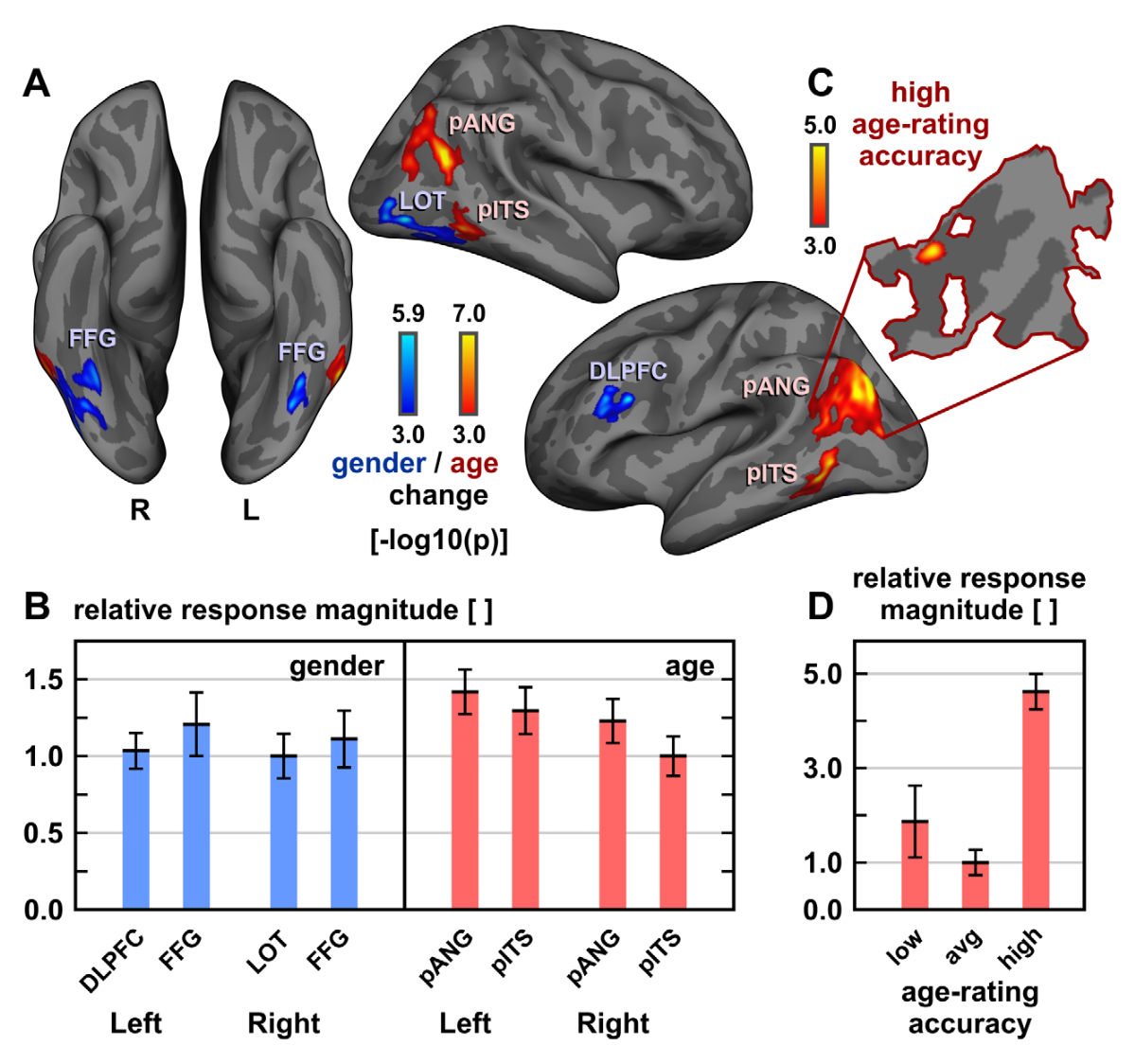
解读:这是全文核心结果图。(A) 表面展开图上年龄条件落在双侧 pANG 与 pITS,性别条件落在双侧 FFG、右 LOT 与左 DLPFC;(B) 归一化的效应量柱状比较,年龄条件呈左半球优势;(C) 左 pANG 团块边界内,最准的 5 名评级者的年龄相关激活高于平均组;(D) 定量化显示高准确组的左 pANG 响应幅值约为平均组近 5 倍(p < 0.001)。该图支撑主要结果第 2–4 条,尤其 (D) 把"隐式观看年龄变化"与"显式年龄判断能力"联系在一起,暗示 pANG 参与的正是年龄的数量表征而非一般注意。
图 5 · 连接 pANG 与 pITS 的垂直纤维束
原文图注:Figure 5. Association pathways subserving facial age processing. Ventral portion of Wernicke's perpendicular fasciculus (WpF) connecting pANG and pITS (average probabilistic path distributions connecting the functional clusters; n = 24, 3D-tract volume rendering thresholded at ≥100 connecting samples passing through each voxel, displayed on sagittal [x = −36 mm] and coronal [y = −54 mm] projection view planes in MNI standard space). pANG, posterior angular gyrus area; pITS, posterior inferior temporal sulcus; orientation labels: L, left; R, right.
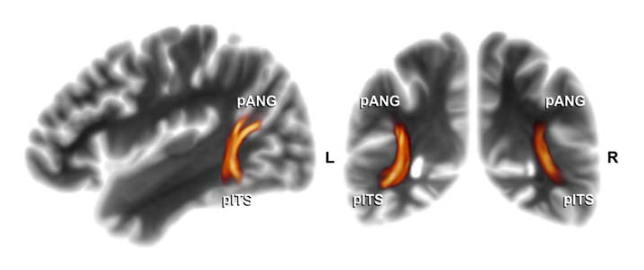
解读:3D 纤维束渲染图,显示 24 名被试平均的概率通路分布——近乎垂直走行的 Wernicke 垂直联合纤维束腹侧部,把后角回(pANG)与后下颞沟(pITS)连起来,MNI 空间矢状位 x = −36 mm、冠状位 y = −54 mm 平面展示,阈值取每体素至少 100 条连接样本。垂直走向是它区别于绝大多数水平走行联合束的标志,也说明腹侧(颞叶)与背侧(顶叶)通路之间可以由这样一条"竖线"打通——对应结果第 5 条的结构部分。
图 6 · 激活概率与连接分数的空间交叉相关
原文图注:Figure 6. Surface-based cross-correlation of fMRI activation probabilities and structural connectivities. Spatial cross-correlation plots (± SEM) between activation probabilities ([−2log10(p)]) and structural connectivity scores ([log10(cs/ns)], with [(cs/ns)] reflecting ratios of connecting samples to the number of samples sent out from each vertex) for pANG, pITS and FFG (cf. Figure 4A), based on two samples: (n = 24) paired with functional data [red] and (n = 46) independent subjects [blue]. Connectivity ratios tend to get bound earlier at maximum values than corresponding activation probabilities. Positive correlations were slightly stronger for the sample with paired fMRI and DWI data (n = 24) compared to the independent sample from the FMRIB DWI database (n = 46; with Spearman's r displayed for the paired/independent sample when significant). However, the latter largely replicate and confirm generalizability of the results. (SEM, standard error of the mean; //**: FWER-corrected p<0.05/0.01/0.001.) pANG, posterior angular gyrus area; pITS, posterior inferior temporal sulcus; FFG, fusiform gyrus.
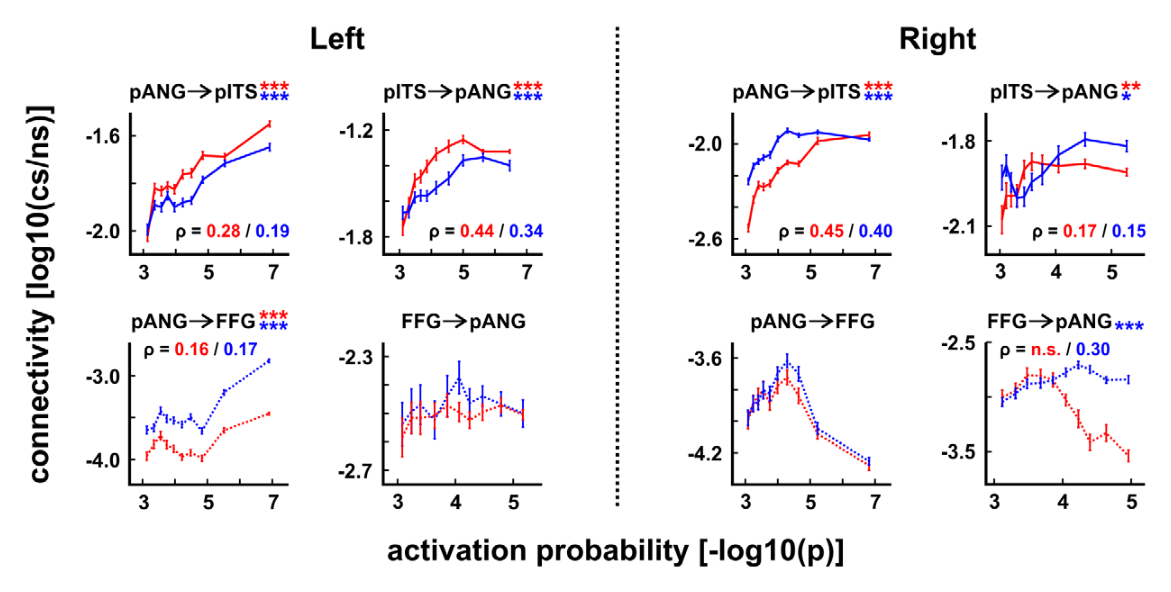
解读:这张图是方法学上最有意思的一张。横轴是结构连接分数(到达某顶点的连接样本数比例的对数),纵轴是激活概率,逐顶点画散点并做 Spearman 相关,红/蓝分别代表配对样本(n = 24)与独立验证样本(n = 46)。pANG 与 pITS 的连接分数与其激活概率呈显著正相关(//** 标注显著性水平,经 FWER 校正),FFG 与 pANG 之间则弱得多(且只在以 FFG 为种子端时偶见)。纵轴横轴的含义合起来读:pITS 连接密度最高的那部分皮层,恰好也是年龄条件下激活最强的那部分——这正是"该白质通路在功能上参与年龄加工"的核心证据。
图 7 · 面部年龄加工网络的模型图
原文图注:Figure 7. Left-hemispheric nodes of the presumed brain network processing the age of faces. 3D model illustrating how the ventral stream, pITS in particular, may interact via Wernicke's perpendicular fasciculus (WpF) with the posterior magnitude-encoding and approximate number system [98,99], pANG in particular, to quantify the varying age of faces. FFG exhibits some connectivity to pANG (cf. Figure 6) but is primarily engaged in processing fixed face attributes such as categorical gender (even if continuously changed over variable androgyny levels like in Figure 1A; see also Figures 2C, 3B and 4A). pANG, posterior angular gyrus area; pITS, posterior inferior temporal sulcus; DLPFC, dorsolateral prefrontal cortex; LOT, lateral occipitotemporal area; FFG, fusiform gyrus; 17–19, Brodmann's areas forming three visual tiers; hMT+, human motion-sensitive temporal cortex; ITG/MTG/STG, inferior/middle/superior temporal gyrus; ITS/STS, inferior/superior temporal sulcus.
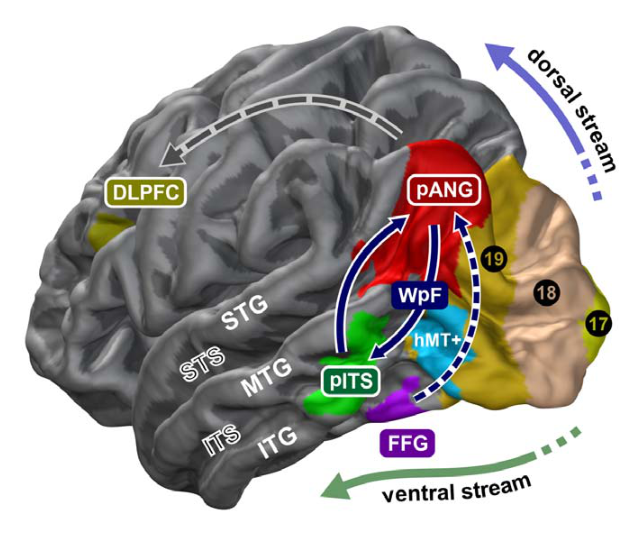
解读:左半球 3D 模型总图,把全部发现拼成一个假设性网络:腹侧视觉通路中的 pITS 通过 WpF 与角回后部(pANG)相连,pANG 属于数量/量值编码与近似数量系统(ATOM 理论与 ANS)的后部核心,二者协同对面部年龄做"量化";FFG 与 pANG 有一定连接但主要负责范畴性别等固定属性;Brodmann 17–19 区构成三级视觉层级,DLPFC、LOT 等其余节点也一并标注。这张图是作者提出模型的示意图,箭头指向为假设而非已证实的因果方向——文中明确承认追踪无法给出信息流方向。
讨论
作者的解读分三层。第一,这是首个面部年龄加工网络的描述:pITS 与 pANG 组成的网络独立于加工范畴性别的 FFG/FFA 系统,也扩展了 Haxby 框架中处理"可变面部属性"(如视线)的核心系统——年龄不像视线那样受注意/意志瞬时控制,而是受个体发生学控制;同时它与吸引力、奖赏相关的系统也判然有别(吸引力判断的激活峰位置更高、更靠前)。第二,作者提出一个机制模型:面部年龄以"增长的数量、可对比的数值量级"来表征,年龄响应的 pITS 借由 WpF 腹侧部接入 pANG——后者是 Walsh 的量值理论(ATOM)与近似数量系统(ANS)的后部加工核心,这与左角回在抽象数字表征、数量比较和心理计算中的已知作用吻合;左半球响应更强、评级能力也落在左 pANG,而稀疏的病人数据(De Renzi 1989)则提示右后部脑损伤患者评估面孔年龄受损,作者认为左右半球可能以不同贡献共同参与。第三,结构—功能耦合本身是方法学贡献:激活概率与连接概率的空间对应为"WpF 直接传递年龄相关信息"提供了活体证据,呼应了近年"连接预测功能特化"的研究取向。
局限方面作者相当坦率:追踪成像无法给出信息流方向,连续渐变范式也无法检测 pITS 与 pANG 之间的时间延迟差,因此二者可能是相互影响的;fMRI 数据的固有平滑加表面平均,使得空间上很近的区域(如右 LOT 与 pITS、FFG 与 pITS)之间的功能—连接相关可能被高估;未检测两半球间交叉相关差异(团块大小与距离效应难以解耦)。作者给出的可检验预测很有意思:用 TMS 扰动左 pANG 应当损害数字化的年龄判断而不损害性别判断;若临床上无法找到年龄与性别失认的分离病例,该模型就会被证伪——而 Bruyer & Schweich 报告的右侧颞枕出血面孔失认患者(性别范畴化受损、年龄分类保留)恰好支持这一方向。
一句话总结
在我看来,这篇文章最漂亮的不是"找到了年龄脑区"这个结论,而是范式设计——年龄与性别正交渐变、心理物理函数先行标定、再用结构连接的概率轮廓去预测激活轮廓——三步环环相扣,把一个几乎没人做过的面部属性做成了结构—功能耦合的范例。把 pANG 拉进"人脸加工"的故事多少有些大胆(它更像一个通用数量模块),但作者"脸敏感节点 + 通用量化模块"的表述其实已经把话说得很谨慎;这是我的理解,因果方向的问题最终还是要靠 TMS 或损伤研究来裁决。
审校与证据追溯 (Verification & Evidence)
图表审计结果
- Fig1: 提取质量
good,对齐度full,识别面板[A, B, C] - Fig2: 提取质量
good,对齐度full,识别面板[A, B] - Fig3: 提取质量
good,对齐度full,识别面板[A, B] - Fig4: 提取质量
good,对齐度full,识别面板[A, B, C, D] - Fig5: 提取质量
good,对齐度full,识别面板[] - Fig6: 提取质量
good,对齐度full,识别面板[] - Fig7: 提取质量
good,对齐度full,识别面板[]
关键事实与局限性声明
- 审校纠偏: {'overclaim_id': 'OVERCLAIM_001', 'classification': 'OVERCLAIM', 'md_section': '讨论', 'current_text': '激活概率与连接概率的空间对应为“WpF 直接传递年龄相关信息”提供了活体证据', 'problem': '这是相关性结构—功能证据,不能证明该纤维束实际传递了年龄信息,也不能确定方向或因果作用。原文在解释部分使用“may be transmitted”和“suggest”,并承认纤维追踪不能确定信息流方向。', 'recommended_fix': '改为“空间对应支持WpF可能参与pITS与pANG之间的年龄相关信息交换,但不能证明信息传递、方向或因果作用”。'} -> 评注:
- 审校纠偏: {'overclaim_id': 'OVERCLAIM_002', 'classification': 'OVERCLAIM', 'md_section': '讨论', 'current_text': 'pITS 与 pANG 组成的网络独立于加工范畴性别的 FFG/FFA 系统', 'problem': '数据支持年龄和性别回归元对应不同的主要激活团块,但不能证明两个网络功能独立。原文还报告FFG与pANG存在一定连接、右LOT与pITS邻近且可能重叠,并明确称pANG的精确作用仍属推测。', 'recommended_fix': '改为“年龄变化与性别变化呈现不同的主要激活分布,但两套区域并非已被证明功能独立”。'} -> 评注:
- 审校纠偏: {'overclaim_id': 'OVERCLAIM_003', 'classification': 'INTERPRETATION', 'md_section': '图注解读:图4', 'current_text': '暗示 pANG 参与的正是年龄的数量表征而非一般注意', 'problem': 'pANG的数量表征角色是作者结合ATOM、ANS及既往数量加工文献提出的机制模型。当前实验没有操纵一般注意或数量表征,也没有相应对照,因而不能排除一般任务、注意或其他抽象量值过程。', 'recommended_fix': '标为作者推论:“结果与pANG参与年龄量值表征的假说一致,但未直接排除一般注意或其他量值过程”。'} -> 评注:
- 审校纠偏: {'overclaim_id': 'OVERCLAIM_004', 'classification': 'INTERPRETATION', 'md_section': '一句话定位/讨论', 'current_text': '脸敏感节点 + 非物体特异的量化模块', 'problem': '这是作者提出的理论模型,不是实验直接确立的事实。pANG并未在本研究中通过独立数量任务或物体年龄条件得到功能定位。', 'recommended_fix': '明确写成“作者提出的工作模型”,并注明尚需数量任务、非人脸年龄刺激、TMS或损伤研究检验。'} -> 评注:
- 补充要点: : (第 8 页)
- 补充要点: : (第 8 页)
- 补充要点: : (第 3 页)
- 补充要点: : (第 3 页)
- 补充要点: : (第 10 页)
- 补充要点: : (第 2 页)