IT Literature Intelligence 终审版本 (VERIFIED) 论文编号:
111| 原始基线:V0_ZCODE_BASELINE| 语义审核:pass| 图表审核:pass
Allocentric Representations for Target Memory and Reaching in Human Cortex
Chen · Annals of the New York Academy of Sciences · 2020 · Zotero itemID=1169
这是一篇发表于《纽约科学院年鉴》"认知神经科学年度进展"专刊的综述,作者 Chen 与 Crawford 把自己实验室近十年关于"记忆引导伸手"(memory-guided reach)的行为学、心理物理学与 fMRI 工作串成一条完整的故事线:伸手目标可以相对地标(landmark)做非自我中心(allocentric)编码,也可以相对凝视做自我中心(egocentric)编码,两套编码在视觉系统早期就分属腹侧/背侧两条通路,但在需要动作时会被尽快转换回自我中心命令。文章的亮点是给出了"转换"(allo-to-ego conversion)本身的皮层定位——右侧楔前叶、双侧背侧前运动区(PMd)和右侧前辅助运动区(Pre-SMA)四个脑区。
研究背景
日常动作的第一步是精确定位目标,而目标位置原则上可以用两种参照系来表征和维持:以眼、头或肩为锚的自我中心参照系,或以场景中某个稳定视觉地标为锚的非自我中心(allocentric,地标中心)参照系——同一只咖啡杯,相对凝视在"右方",相对笔记本电脑却在"左方"。Milner 与 Goodale 1992 年的知觉-行动双通路模型认为:背侧通路(与额叶紧密互连的顶叶皮层)计算目标相对观察者的绝对度量以执行需要实时更新的动作,腹侧通路则不考虑目标的自我中心位置,而利用目标与场景中其他物体的空间关系来知觉。单一通路损伤病人提供的"双重分离"是这一框架的经典证据:双侧枕叶外侧(腹侧流)损伤者患视觉性失认,无法做宽度/朝向的知觉判断,却能准确伸手抓握、张手幅度恰当;而后顶叶皮层(PPC)损伤者患视性共济失调(optic ataxia),伸手错位、手部定向与抓握缩放困难,但物体知觉完好。
缺口在于两点。其一,行为学证据虽多(无地标时自我中心记忆在数秒内衰退;有地标时目标位置可稳定维持数秒;两线索并存时被最优整合),但"地标引导伸手"的皮层机制直到近年才被直接检验——此前人类影像学研究只覆盖了认知任务中的 allocentric 空间判断或手动距离估计,从未测过以地标编码的伸手目标。其二,即使知道了 allocentric 表征在哪、egocentric 表征在哪,"前者在哪里、何时、如何转换成后者"仍然未知。这篇综述正是围绕这两点,按行为—编码—转换—总模型的顺序展开。
研究思路
作者的总体策略是"把记忆延迟当作手术刀"。由于记忆延迟迫使被试更多依赖腹侧流的 allocentric 表征,一个带延迟期的实验设计就成了分离各加工阶段的关键:早期目标表征(egocentric 和/或 allocentric 坐标)→ 把视空间编码转换为 egocentric 伸手计划 → 运动执行。行为层面用"线索冲突"范式分离两种线索各自的贡献与权重;时间层面设计"尽早转换 vs 最后转换"的竞争性预测;影像层面用事件相关 fMRI 把"目标位置记忆阶段"与"伸手计划/执行阶段"在时间上切开,从而能在延迟期内单独检验目标记忆的方向选择性(directional selectivity),而不是把记忆与运动计划混在一起。
逻辑链条大体是三步走:先确立行为规律(两线索按可靠性最优整合、转换发生在"第一时间机会"),再用 fMRI 回答"两种编码分别由哪些脑区负责"(颞叶 ITG 对地标、枕叶 SOG 对凝视),最后用巧妙的时间操作(口头提示地标是否移位)把"转换发生的那一刻"锁定在某几个脑区上。每一步都以先前的实验预测开路——例如转换实验的预测 (1)(2)(3) 是事先写明的——这是这套工作方法论上最可学的地方。
方法
行为/心理物理部分(Fig.1 的任务,Byrne 与 Crawford 2010):被试注视中央十字,短暂的伸手目标被四个"振动"的地标包围——地标以小(稳定)或大(不稳定)振幅振动,操纵对地标稳定性的主观判断;刺激消失后注视点做小或大移动,操纵自我中心线索的可靠性(注视点不再可用作地标);随后地标以偷偷平移后的集体中心短暂重现,使目标在自我中心坐标与 allocentric 坐标中的位置被解离(原始位置 T,若保持 allocentric 坐标则目标应位于 T′);最后被试凭记忆伸手。分析时把伸手指点旋转到与 T–T′ 对齐的坐标系,allocentric 权重取最终伸手向量在该连线上的投影。时间转换行为实验(Chen 等 2011,Fig.2):三种条件(纯 egocentric、纯 allocentric、转换条件——地标在延迟前与延迟后各重现一次,被试可以自主选择早转或晚转),比较 2.5、5.5、8.5 秒三个延迟下伸手误差椭圆面积的变化模式。
fMRI 编码研究(Chen 等 2014,Fig.3):事件相关设计,三种任务(egocentric 伸手、allocentric 伸手、颜色报告对照)使用完全相同的视觉刺激(红/绿目标加地标),仅靠听觉指令区分;关键是延迟期只指定目标位置而伸手方向未知,地标在延迟后才重现(allocentric 任务)或直接进入反应期(egocentric 任务),据此分别检验延迟期与反应期的方向选择性对比,如(目标在凝视右侧)>(目标在凝视左侧)、(目标在地标左侧)>(目标在地标右侧)。fMRI 转换研究(Chen 等 2018,Fig.4):所有被试都在第一个延迟期以 allocentric 方式编码目标,之后口头指令提示地标将原位重现(same cue,可在指令期就转换)或移位重现(different cue,须等反应期前地标重现才能转换);对两个预期转换时刻做组间对比——same>different(指令期)与 different>same(反应期)——取两个对比检出区域的交集,即转换专属脑区。
主要结果
- 行为上两线索按可靠性最优整合(Fig.1):最终伸手方向平均从原目标位置向 T′(若目标保持在 allocentric 坐标的位置)偏移约 1/3,且该权重与最大似然估计(MLE)模型基于独立单线索控制实验实测可靠性给出的预测一致;但权重还受地标"被感知的稳定性"影响——振动小(看起来稳)比振动大(看起来不稳)时 allocentric 权重更高,即使这并未改变其作为空间线索的实际可靠性。后续自然场景多线索研究提示 allocentric 权重还取决于线索的任务相关性。
- 转换的时机在"第一时间机会"(Fig.2):纯 egocentric 任务的伸手误差随延迟(2.5→5.5→8.5 s)递增,纯 allocentric 任务不受延迟影响;转换条件下被试本可早转或晚转,但误差模式与 egocentric 任务相同——随延迟递增,说明一旦口头/视觉线索使伸手方向可算,allocentric 表征就被立即转换成 egocentric 命令,而不是留到动作前最后一刻(实验室任务中这并非最优策略,现实世界可能是反应时优先)。
- 延迟期内两种编码分属不同脑区(Fig.3B):allocentric 方向选择性见于颞下回(ITG,inferior temporal gyrus),egocentric(相对凝视)方向选择性见于枕上回(SOG,superior occipital gyrus),而枕下回(IOG)对两种编码都参与,提示它是两种视空间编码分工前(腹侧 ITG vs 背侧 SOG)的共同中心;延迟期内顶叶-额叶无 egocentric 方向选择性(因为伸手方向还未知)。
- 反应期由顶叶-额叶网络接管 egocentric 伸手方向(Fig.3B):伸手方向被指定后,主要在左半球(对侧于伸手手)的中央上小叶前部(SPL)、后顶内沟(pIPS)、M1、S1、PMd 在两种伸手任务中都表现出对侧 egocentric 方向选择性;另有右半球 mIPS、角回(AG)、pIPS、SPL 对相对凝视的左/右伸手表现出选择性。这与记忆引导伸手的影像文献及无需延迟的 fMRI 适应研究(M1、PMd、PPC 的运动方向选择性)一致。
- 转换专属脑区有四个(Fig.4B):first delay 中 ITG 与 IOG 出现 allocentric 目标方向编码(两种任务相同,且此时无 egocentric 选择性);egocentric 伸手选择性在 same cue 任务中紧跟口头指令出现、在 different cue 任务中等地标重现后才出现,与预测吻合;而(指令期 same>different)与(反应期 different>same)两个对比的交集给出四个特异于 allo-to-ego 转换的区域——右楔前叶(precuneus)、右 Pre-SMA、双侧 PMd,且不受线索模态与时间安排的影响。
图注解读
图 1 · 两种参照系与双线索最优整合的心理物理证据
原文图注:Figure 1. Demonstration of egocentric and allocentric reference frames for target coding and psychophysical evidence for optimal integration of both cues. (A) An example illustrating egocentric and allocentric target coding for reach. A person is sitting at his/her desk and reading a book; there are a cup of coffee and a laptop on his/her desk. He/she is reaching for his/her cup. As shown here, the location of this cup (reaching target) can be represented as being to the right of his/her gaze, which is in an egocentric reference frame, or defined as being to the left of the laptop, which is in an allocentric reference frame, where the laptop is used as an allocentric landmark.
(A) 用书桌场景直观定义两种编码:伸手目标(咖啡杯)既可编码为"凝视之右"(自我中心),也可编码为"笔记本电脑之左"(以笔记本为 allocentric 地标)。(B)-(E) 是核心实验:B 展示振动地标(操纵主观稳定性)与注视点移动(操纵自我中心噪声)如何引入两种线索的可靠性因子;C 给出原目标 T、allocentric 位置 T′(大蓝圈)与实际伸手指点(小红圈)三者的几何关系;D 把数据旋转到 T–T′ 连线坐标系,使 allocentric 权重等于伸手向量在该线上的投影;E 汇总按 T′ 移位方向分层的平均趋势——黑色准环形数据(最终伸手方向)落在从 T 到 T′ 约 1/3 的位置。这张图支撑主要结果第 1 条:整合接近 MLE 预测,且受主观稳定性启发式影响(引文标注 Modified from Ref. 8)。
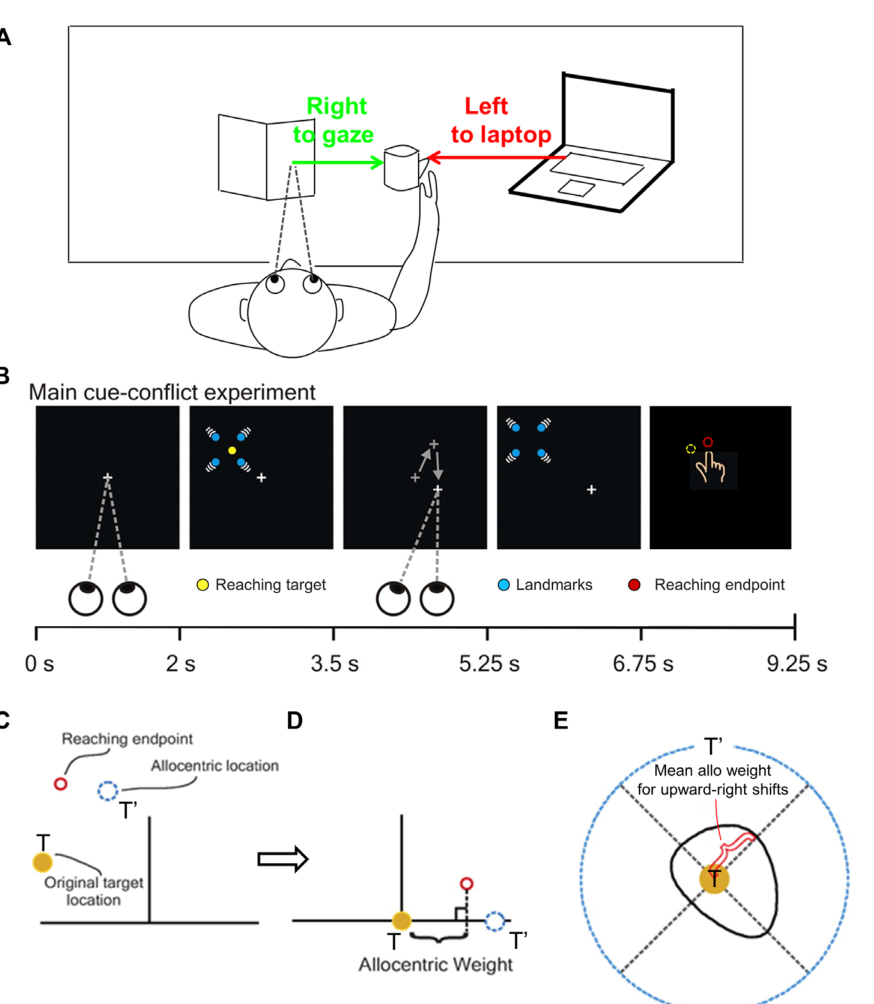
图 2 · 转换时机的行为学检验
原文图注:Figure 2. A behavioral study testing the timing of allocentric-to-egocentric conversion of remembered reach targets. (A) Three reach tasks where subjects are asked to reach toward the remembered reach target after a variable delay period. In the egocentric condition (top row), only a reach target (filled yellow disk) is briefly displayed in the periphery. In the allocentric condition (middle row), the reach target is presented along with the surrounding allocentric landmarks (four blue disks) before the variable delay, and subjects are required to remember the target location relative to the landmarks. After the variable delay, the landmarks briefly reappear at a new location, and subjects are instructed to reach toward the remembered target relative to the shifted landmarks. The allo-to-ego conversion condition (bottom row) is similar to the allocentric condition, but the shifted landmarks first reappear before the variable delay, then again immediately after the delay, just before reach responses, which leaves subjects implicitly free to convert allocentric representations into egocentric representations either early (right after the first reappearance of landmarks, before the variable delay) or later (after the second representation of the landmarks, after the variable delay).
(A) 三行任务图解是读图关键:顶行只有外周目标(黄盘);中行目标与四个蓝盘地标同现、延迟后地标移位重现、被试按新地标相对位置伸手;底行的转换条件中移位地标先在延迟前重现一次、延迟后再次重现,被试可自主选择早转(延迟前)或晚转(延迟后)。(B) 纵轴为以伸手误差椭圆面积(cm²)计算的伸手动差,横轴为三种延迟(2.5、5.5、8.5 s)。效应方向:egocentric 面板误差随延迟单调上升,allocentric 面板平坦,转换面板与 egocentric 同型——这就是"第一时间机会转换"的行为学证据,支撑主要结果第 2 条(引文标注 Modified from Ref. 9)。
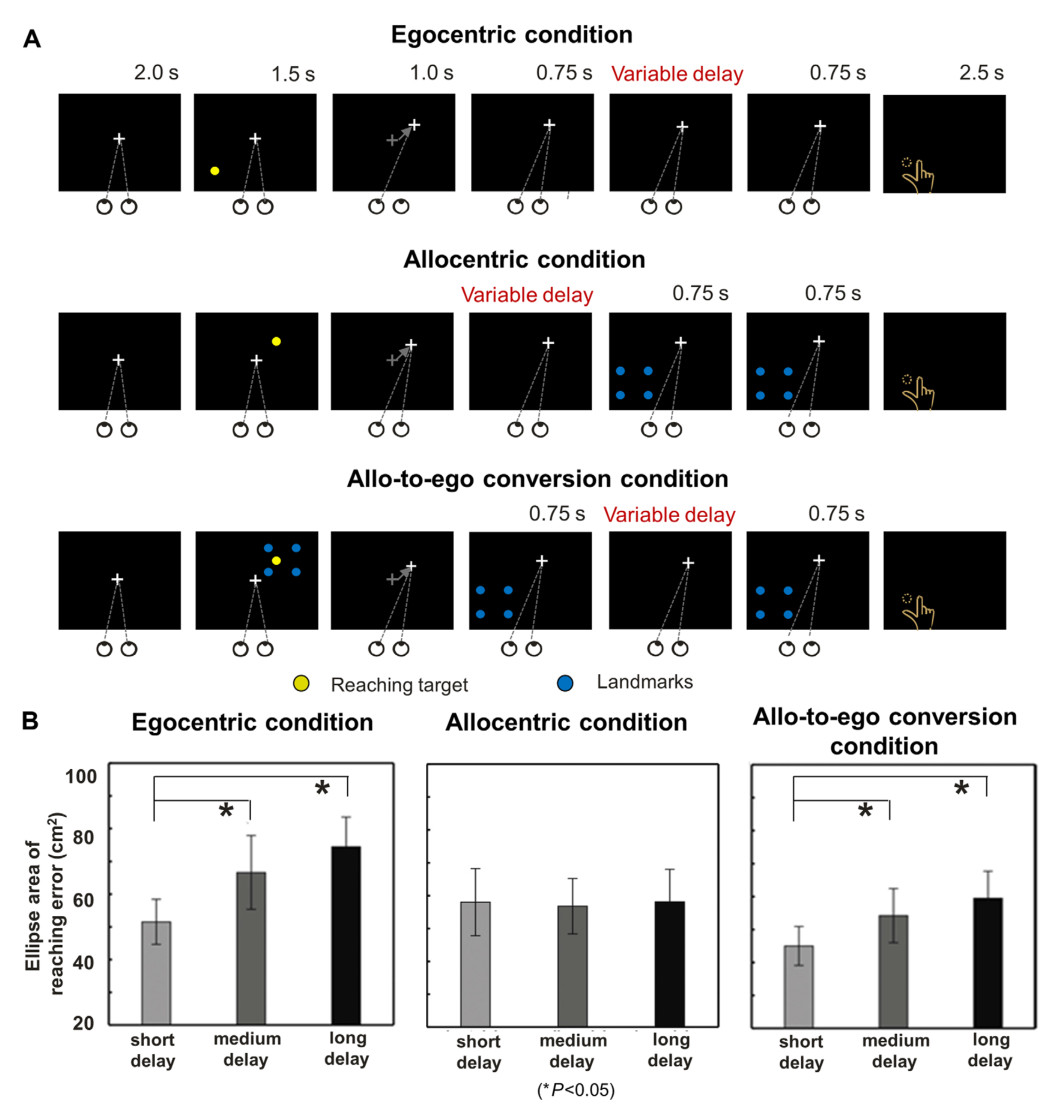
图 3 · 区分两种编码的事件相关 fMRI 设计与结果
原文图注:Figure 3. An event-related fMRI design to distinguish human brain areas involved in allocentric versus egocentric representations of remembered reach targets. (A) Experimental paradigm. The display of visual stimuli is the same for the three tasks (egocentric reach, allocentric reach, and color report (as a control)). Two colors (green or red) were used as the target to be reported in the control task and to be reached in the two reach tasks. In the former task, participants were required to press a button one or two times, depending on whether the target was green or red. Similar to behavioral studies of memory-guided reaching, subjects made reaching error, thus the reaching finger did not align with the original target location, as illustrated in the response phase in A. The critical difference between the two reach tasks is the frame of the reference used to encode reach target location. Target location is represented and maintained relative to the self in the egocentric reach task but relative to an independent landmark in
(A) 实验范式的要点是三任务视觉刺激完全相同、只有听觉指令不同,且延迟期(phase 3)只呈现目标位置、伸手方向留待后续指定——这使方向选择性对比可以严格落在记忆阶段。(B) 是叠加在某个代表性被试充气脑表面(侧面观)上的体素激活图:橙色为延迟期"目标在凝视右侧 > 左侧"对比检出的 egocentric 目标记忆编码区(SOG 一线);蓝色为延迟期"目标在地标左侧 > 右侧"对比检出的 allocentric 编码区(ITG 一线);紫色为两者共同涉及的区域(IOG);黄色为反应期"目标在凝视右侧 > 左侧"对比检出的 egocentric 伸手方向编码区(SPL、pIPS、S1、M1、PMd 等)。读图即"颜色即功能":蓝橙分离支撑主要结果第 3 条,黄色支撑第 4 条(引文标注 Modified from Ref. 11)。
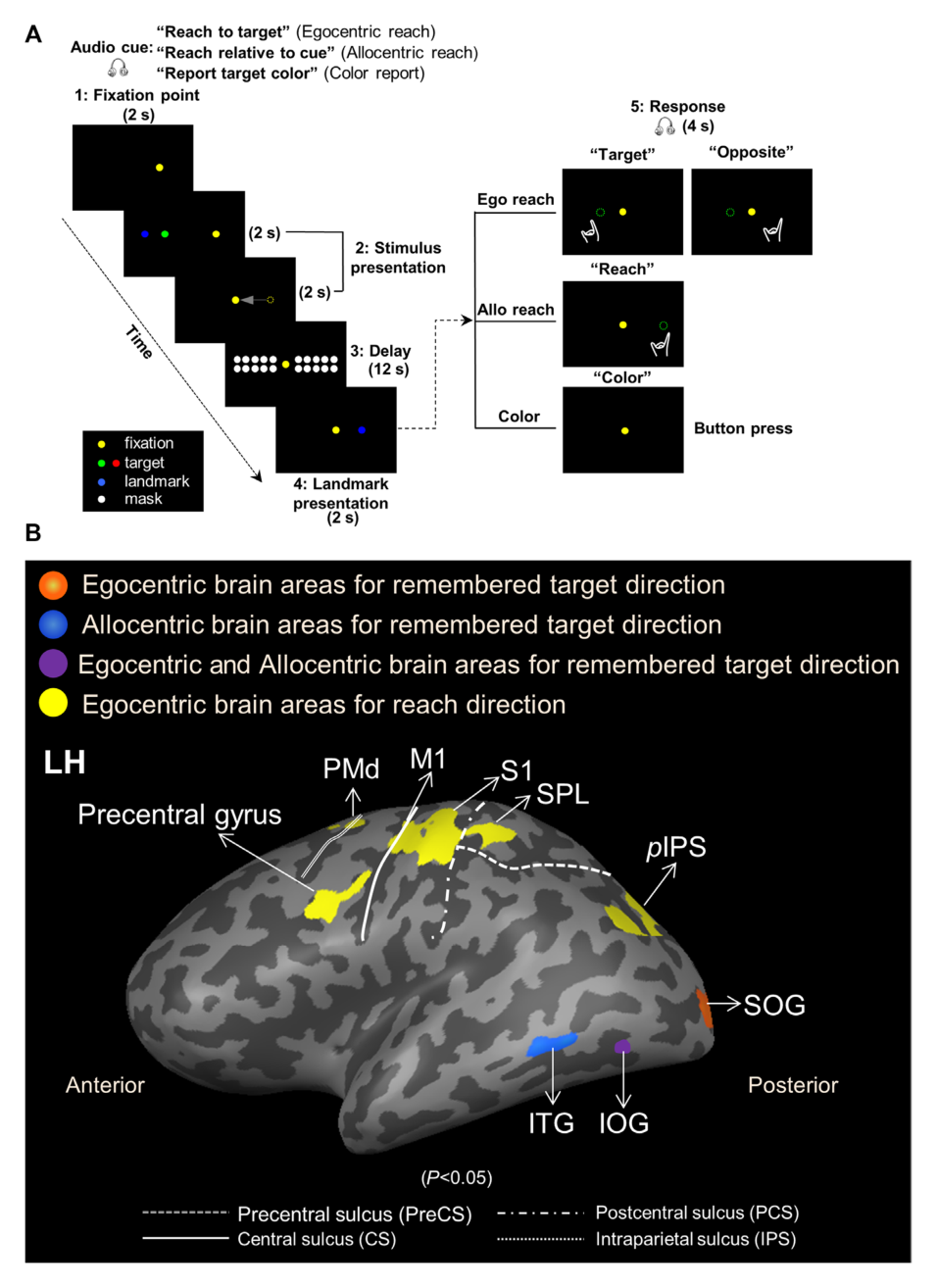
图 4 · 锁定 allo-to-ego 转换脑区的 fMRI 实验
原文图注:Figure 4. An event-related fMRI study investigating neural substrates for allocentric-to-egocentric conversion of remembered reach targets. (A) Experimental paradigm. The presented visual stimuli are the same for the two reach tasks: same cue and different cue. For both tasks, reach target location is encoded and maintained relative to an allocentric landmark during first delay. After that phase, the early opportunity of converting the allocentrically represented targets into egocentric plan is different for the two tasks. In the same cue task, the allo-to-ego conversion happens during the verbal instruction phase when direction of an upcoming reach can be inferred by the verbal cue; by contrast, in the different cue task, this conversion emerges during the response phase after the visual cue of reappearance of the landmark at a new location to specify reach direction.
(A) 范式的巧妙在于把"转换机会"做成两个任务间唯一的时间差异:same cue 任务中口头指令已足以推出伸手方向,转换可提前到指令期;different cue 任务中必须等地标在反应期前移位重现才知道方向,转换被迫推迟。(B) 为充气脑上的体素激活图:蓝色为第一个延迟期"目标在地标左侧 > 右侧"对比检出的 allocentric 目标记忆编码区(ITG、IOG);橙色为"转换"专属区,由两个对比的合取(conjunction)检出——指令期 same>different 加上反应期 different>same——即右楔前叶、右 Pre-SMA 与双侧 PMd。合取逻辑是本图的读图核心:只有"该转换时活跃、不该转换时不活跃"的区域才算转换区,它直接支撑主要结果第 5 条的四区结论(引文标注 Modified from Ref. 12)。
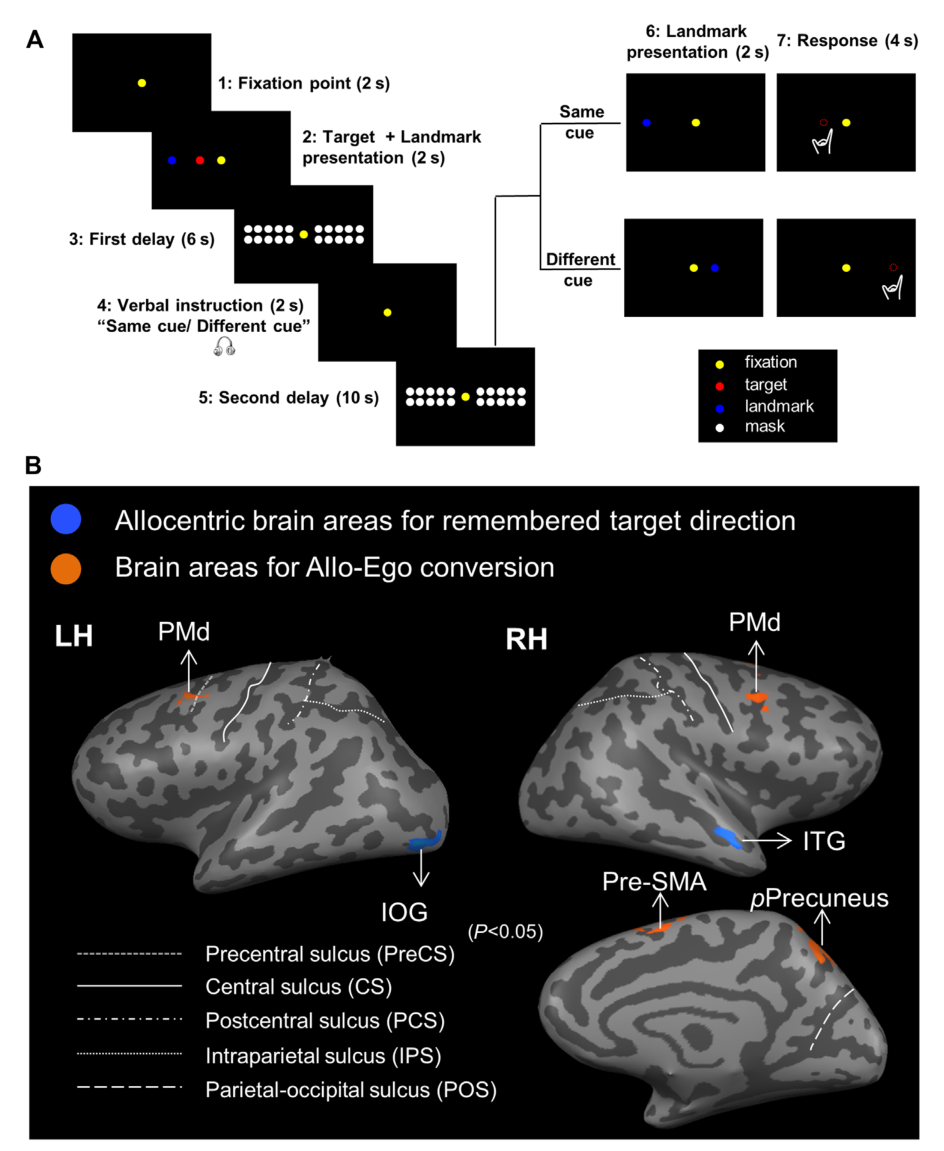
图 5 · 总体功能模型
原文图注:Figure 5. Overview of human brain areas for coding of allocentric and egocentric reach target direction in memory, allo-to-ego conversion and egocentric reach direction, and visuomotor transformations. (A) Cortical regions (lateral view) involved in allocentric versus egocentric directional selectivity of remembered reach targets, conversion from allocentric representations into egocentric plan, and egocentric reach directional selectivity. AG, angular gyrus; mIPS, midposterior intraparietal sulcus; CS, central sulcus; PCS, postcentral sulcus; PreCs, precentral sulcus. (B) Target location represented in allocentric coordinates enters egocentric reach systems by converting it into egocentric representation at the first possible opportunity, and then it goes through a series of egocentric transformations to execute reach movements.
(A) 是把前两张 fMRI 图的全部发现叠到一张侧面观脑图上的功能总览:记忆中的 allocentric 目标方向(腹侧 ITG)、egocentric 目标方向(SOG)、转换区(楔前叶、PMd、Pre-SMA)与 egocentric 伸手方向(SPL、pIPS、mIPS、AG、M1、S1、PMd)各占其位,图中还标注了中央沟(CS)、中央后沟(PCS)、中央前沟(PreCs)等解剖界标。(B) 是流程图:allocentric 坐标中的目标位置在"第一时间机会"被转换成 egocentric 表征,随后与 egocentric 表征的目标一样经历一系列自我中心变换直至运动指令下达效应器(手)。这张图是全文的收束——支撑讨论部分的双通路分-合模型:早期分离、顶叶-额叶再整合,且楔前叶与 PMd 是转换通路与伸手规划通路的共享节点。
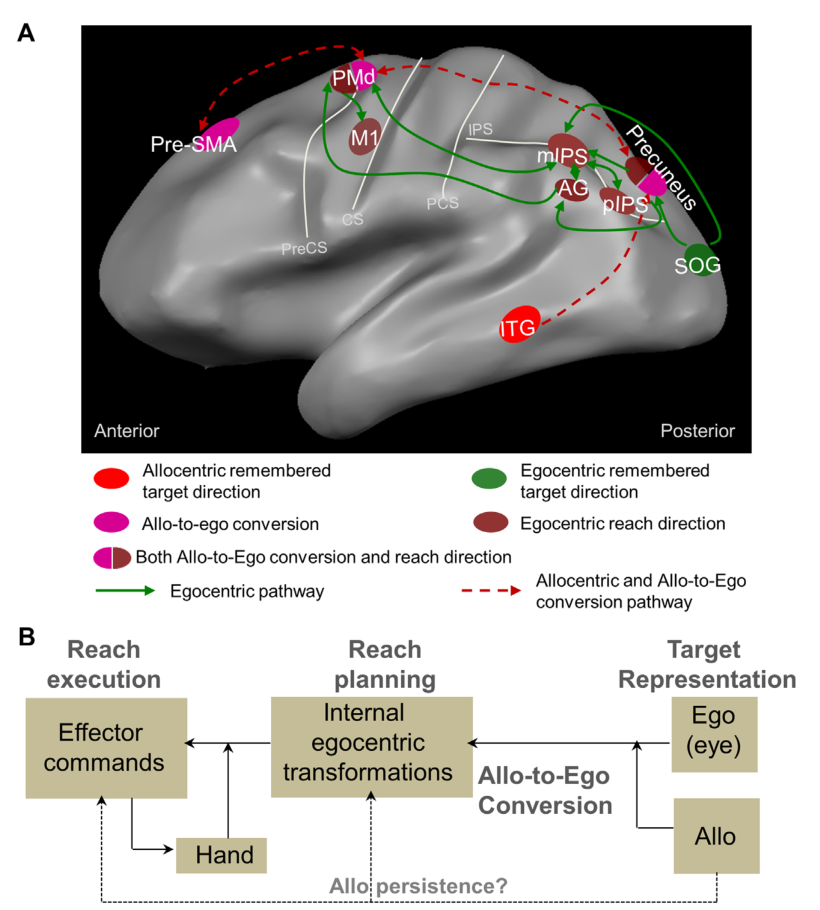
讨论
作者把发现组织成一个"早期分离、晚期再整合"的功能模型:egocentric 目标信息从早期视觉皮层经背侧枕叶流入顶叶-额叶高级区(楔前叶、pIPS、mIPS、AG、PMd),在那里完成内部 egocentric 变换并形成伸手计划,运动命令最终发给 M1;而以地标为中心的目标方向记忆在颞下皮层维持,需经楔前叶、PMd、Pre-SMA 转换成 egocentric 表征后才能进入 egocentric 伸手系统,其中楔前叶与 PMd 是转换通路与伸手规划通路共享的皮层节点。作者直面了两处张力:颞叶皮层参与伸手编码表面上与知觉-行动解耦的主流说法矛盾,但这一矛盾被认为依赖于记忆延迟的存在;而"一切空间表征最终都是 egocentric"的立场(Filimon)虽然可能为真,地标中心编码确实有一种特殊需求——保持目标与地标间特定的相对空间构型,这也许正是擅长维持特征构型的颞叶皮层被招募的原因。双通路的冗余乍看浪费,实则各有优势:纯 egocentric 变换更快,allocentric 变换在时间上更稳定,二者组合最优,也解释了皮层损伤后的功能恢复。作者承认的开放问题包括:行为学显示地标在伸手执行期间仍持续影响动作,但其来源不明——可能腹侧的 allocentric 编码只服务于最初的目标编码、在运动计划阶段就被完全转换,也可能存在持续的 allocentric 影响;受 fMRI 时间分辨率与运动伪影敏感性的限制,这一问题需要别的手段。结论部分给出三点贡献(两种编码机制不同、记忆中的目标方向编码与伸手方向编码机制不同、四个转换专属区)以及临床含义:egocentric 区损伤的病人可被训练更多依赖环境中的 allocentric 线索完成日常活动,而转换区损伤则可能使 allocentric 信息失效——区分"allocentric 区、egocentric 区与转换区"的损伤可指导不同的康复策略。
一句话总结
这篇综述最有说服力的地方是每一步都让行为预测走在影像前面:先用误差随延迟衰减的模式证明大脑"能早转就早转",再用合取对比把转换这件事钉死在右楔前叶、双侧 PMd 和右 Pre-SMA 四个区上——我自己的理解是,这提示转换更像一个被"机会"触发的主动计算过程,而非伸手执行前的被动收尾;不过转换区与伸手规划区共享楔前叶和 PMd,其特异性到底有多干净,仍值得追问。
审校与证据追溯 (Verification & Evidence)
图表审计结果
- Fig1: 提取质量
good,对齐度full,识别面板[A, B] - Fig2: 提取质量
good,对齐度full,识别面板[A] - Fig3: 提取质量
good,对齐度full,识别面板[A] - Fig4: 提取质量
good,对齐度full,识别面板[A] - Fig5: 提取质量
good,对齐度full,识别面板[A, B]
关键事实与局限性声明
- 审校纠偏: 无显著过度推论。解读中较强的表述(如“钉死在……四个区上”“两套编码在视觉系统早期就分属腹侧/背侧两条通路”)均有原文对应(摘要与 Fig.4B 合取结果);“我自己的理解是……”一段已明确标注为解读者个人推论,未冒充作者结论。相关性未被夸大为因果。
- 补充要点: 原文明确保留了一个重要限定:四个转换区(右楔前叶、右 Pre-SMA、双侧 PMd)并非转换功能专属,既往文献提示它们还承担大背景内 allocentric 目标自动编码、egocentric 变换与一般伸手规划等多重功能(p10,“This does not mean that they are exclusive for these functions”)。解读仅在“一句话总结”中以提问形式间接触及,正文结果/讨论部分未陈述该限定,建议补一句。
- 补充要点: 讨论中关于“地标在伸手执行期间仍持续影响动作”的开放问题,原文给出两种可能解释(腹侧 allocentric 编码只服务初始编码、计划阶段即被完全转换 vs 存在持续 allocentric 影响);解读基本覆盖,但未点明原文将此与 Goodale et al. 2004 / Rossetti 1998 的“短时程运动表征”立场挂钩,属可接受的省略。